

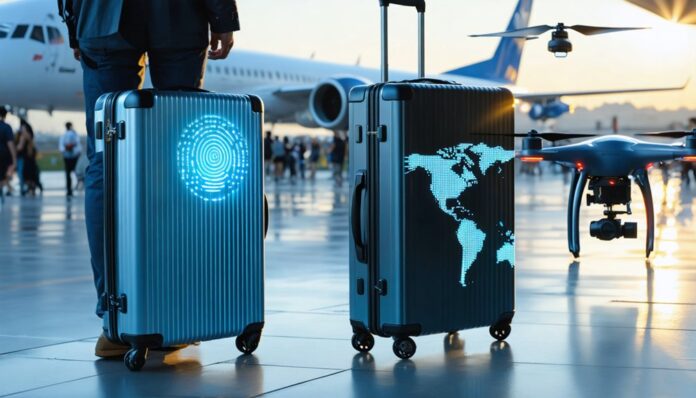

Smart travel gear merges real‑time GPS and Bluetooth tracking, removable‑battery power banks, encrypted app‑controlled locks, and built‑in scales to streamline journeys and boost security. GPS offers outdoor precision, while Bluetooth excels indoors, ensuring bags are located throughout airports. Power banks keep devices charged during layovers, and remote locks deter theft with tamper alerts. Integrated scales prevent overweight fees, and firmware updates continuously enhance safety features. Continued exploration reveals deeper insights into selecting the best system for frequent flyers and digital nomads.
Key Takeaways
- Integrated GPS and Bluetooth tracking provide real‑time location updates, reducing lost‑luggage anxiety and enabling quick recovery.
- App‑controlled, TSA‑approved locks with encryption and tamper alerts secure bags and notify owners of unauthorized access.
- Built‑in scales and compression panels help travelers stay within weight limits and keep items organized, avoiding fees.
- Removable, airline‑compliant batteries power built‑in chargers and IoT features while meeting safety regulations.
- Subscription services and firmware updates deliver personalized packing tips, continuous security patches, and location history for enhanced convenience.
Why Smart Luggage Is Growing Fast and What It Means for Travelers
Accelerating adoption of connected travel accessories is reshaping the luggage market, as evidenced by a surge in valuation from $2.5 billion in 2025 to $2.96 billion in 2026 and a projected $5.79 billion by 2030, reflecting compound annual growth rates above 18 %. The rapid rise stems from soaring global air travel, a 13.6 % YoY increase in international traffic, and a consumer shift toward premium, IoT‑enabled gear that promises convenience, safety, and personalization. Urban mobility trends amplify demand for seamless, biometric‑locked bags that integrate with smartphones, while strategic retail partnerships expand showroom presence and online reach. Together, these forces forge a community of tech‑savvy travelers who expect smart luggage to enhance every journey, reinforcing brand loyalty and collective identity. IATA passenger metrics highlight the surge in travel demand. The market is projected to reach $11.24 billion by 2033, driven by a 12.7% CAGR across 2026‑2033. The premiumization trend is further accelerated by product innovation that adds built‑in chargers and GPS tracking.
Real‑Time Tracking: How Smart Luggage Finds Your Bags
The surge in smart‑luggage adoption naturally leads to a focus on how these devices are located in real time. RFID tags transmit data wirelessly, delivering high RFID accuracy at checkpoints such as security gates and conveyor belts, while GPS chips log global positions in central IoT databases. Airports like Schiphol and Frankfurt integrate self‑learning models and RFID‑based sorting to prevent misrouting, and Bluetooth trackers such as AirTags add crowd‑sourced proximity alerts. Passenger apps receive continuous updates via platforms like SITA Bag Journey, offering predictive arrival times and instant notifications when bags reach claim areas. This transparency reduces anxiety, fosters a sense of community among travelers, and safeguards passenger privacy by limiting data to flight‑linked identifiers rather than personal profiles. Greek island airports have introduced handheld mobile computers with special software to speed up and improve the accuracy of baggage scanning. UWB radar enhances obstacle detection for auto‑following luggage. Human mistakes can be quickly identified and corrected when RFID data pinpoints the exact location of a misrouted bag.
Built‑In Power Banks: Keeping Devices Charged on the Go
Often travelers overlook that a smart suitcase’s built‑in power bank can transform a long layover into a productive interval, provided the device complies with airline regulations.
A well‑engineered unit houses a removable battery in a zippered compartment, allowing the traveler to extract the pack before checking the bag and carry it on‑board, satisfying regulatory compliance. The external USB‑A and USB‑C ports, often powered by GaN fast‑charge chips, deliver up to 10 000 mAh capacity, enough for five iPhone full charges or a laptop top‑up.
Designers limit energy to 100 Wh for standard approval, with optional 160 Wh upgrades after airline permission, and they protect terminals against short‑circuiting. Fast‑charging capabilities ensure quick replenishment during short layovers. This integration eliminates separate chargers, streamlines cabin routines, and reinforces a sense of belonging among tech‑savvy globetrotters. Non‑removable lithium batteries are forbidden in checked bags. U.S. airlines have banned luggage with non‑removable batteries, so the removable design is essential.
App‑Controlled Locks: Remote Locking to Prevent Theft
Securing luggage with an app‑controlled lock transforms passive protection into proactive defense.
The device pairs via Bluetooth or NFC, allowing remote locking from a smartphone within 65 feet of a 2.4 GHz router and delivering tamper alerts instantly when unauthorized access is attempted.
TSA‑approved metal construction endures handling, while a backup physical key offers redundancy.
Real‑time movement alerts notify users if the bag leaves the defined radius, and an activity log records each entry, supporting community trust among travelers.
Multi‑layer encryption safeguards directional codes, and “Away Mode” restricts access to the master code during trips.
Rechargeable batteries, IP54/IP55 weather resistance, and customizable auto‑lock intervals guarantee durability, making the lock a reliable, belonging‑enhancing companion for modern journeys.
Compact, sleek design ensures minimal bulk while maintaining robust security.
Bluetooth vs. GPS: Which Tracking Tech Works Best at Airports?
Comparing Bluetooth and GPS for airport tracking reveals a trade‑off between global reach and indoor precision. GPS offers satellite‑based coverage across terminals and parking lots, delivering 1‑5 metre accuracy outdoors and real‑time updates every 30 seconds without local infrastructure. However, signal interference from concrete and metal structures degrades indoor performance, leaving luggage and vehicles poorly located within terminals.
Bluetooth, by contrast, excels in indoor environments through beacon integration and gateway networks, narrowing location to specific rooms or gates. Its short‑range communication conserves battery life but depends on nearby phones or receivers, limiting range to a few hundred feet. Consequently, GPS dominates outdoor parking scenarios, while Bluetooth provides superior proximity tracking inside terminals, each technology complementing the other’s weaknesses.
How Built‑In Scales Keep Your Carry‑On Within Airline Limits
Eliminating surprise fees, built‑in scales let travelers verify carry‑on weight instantly, ensuring compliance with airline limits before reaching the gate. The devices embed a digital sensor within the telescopic handle, where handle ergonomics provide a natural grip and lift that triggers the measurement.
Scale accuracy is calibrated to within a tenth of a kilogram, displaying the exact weight on an LED readout or linked smartphone app. Indicator lights flash when the bag exceeds typical 7–10 kg thresholds, prompting immediate repacking without last‑minute stress.
How Noise‑Cancelling Translation Earbuds Complement Smart Luggage and Reduce Travel Stress
Built‑in scales eliminate surprise overweight fees, and the next logical enhancement for stress‑free journeys is auditory assistance that guarantees clear communication amid bustling terminals.
Noise‑cancelling translation earbuds integrate voice isolation and AI‑driven multilingual processing, allowing travelers to converse with locals, staff, and fellow passengers without background interference. Beamforming microphones and four‑mic ENC systems filter airport chatter, while models such as the TREBLAB X‑Smart deliver sub‑65 ms latency across 40+ languages.
Battery longevity—up to 10 hours of continuous translation and 40 hours standby—ensures uninterrupted service through layovers, flights, and ground transport. Offline language packs further reduce anxiety when connectivity lapses, creating a seamless auditory link that complements smart luggage tracking and fosters a sense of belonging within the global travel community.
How to Choose Smart Luggage for Frequent Flyers and Digital Nomads
For travelers who spend weeks hopping between airports or setting up temporary workspaces, the right smart luggage must align with both the pace of frequent flying and the versatility demanded by digital nomadism.
Selecting a model begins with matching core features to lifestyle: GPS tracking and Bluetooth locks reduce loss anxiety on international itineraries, while built‑in scales and packing ergonomics prevent overweight fees and streamline security checks.
Durable aerospace‑grade shells and spinner wheels guarantee resilience through constant handling.
Nomads prioritize removable TSA‑compliant batteries, long‑lasting USB power banks, and compression panels that hide cables and accessories.
Capacity matters—48 L options like the AERO Trunk accommodate office gear without sacrificing mobility.
Finally, evaluate subscription services for firmware updates, location history, and personalized packing tips, guaranteeing the luggage evolves with the traveler’s community.
References
- https://www.fortunebusinessinsights.com/smart-luggage-market-104615
- https://www.news.market.us/luggage-statistics/
- https://thegadgetflow.com/blog/ces-2026-travel-tech/
- https://www.theinnatstonecliffe.com/blog/the-ultimate-packing-list-best-items-for-travel-in-2026-including-mackinac-island-essentials
- https://www.smartertravel.com/the-real-rules-for-carry-on-luggage/
- https://www.thebusinessresearchcompany.com/report/smart-luggage-global-market-report
- https://www.skyquestt.com/report/smart-luggage-market
- https://www.technavio.com/report/smart-luggage-market-industry-analysis
- https://www.grandviewresearch.com/industry-analysis/smart-luggage-market-report
- https://www.gminsights.com/industry-analysis/smart-luggage-market