

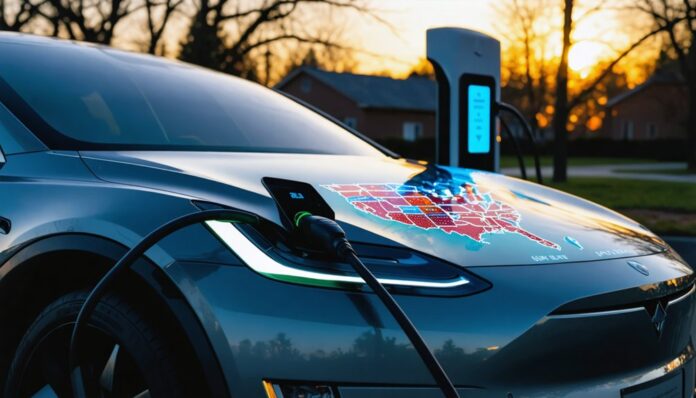

Electric vehicle charging costs differ markedly depending on where a driver lives. A resident in Kansas may pay nearly half what someone in Hawaii pays for the same kilowatt-hour. These gaps stem from electricity markets, state policy, and infrastructure investment. The variation affects real budgets in measurable ways. Understanding which states offer the lowest costs—and why—reveals something worth knowing before the next charge.
Key Takeaways
- Home Level 2 charging averages $0.12–$0.22/kWh nationally, while public DC fast charging averages $0.45–$0.51/kWh—more than double the cost.
- Nebraska offers the cheapest public DC fast charging at $0.17/kWh; Hawaii is the most expensive at roughly $0.515/kWh.
- Annual EV charging costs range from ~$437 in low-rate states to ~$1,176 in high-rate states, versus ~$1,926 for gasoline nationally.
- Northeast and coastal states carry the highest per-mile charging costs; Southern and Mountain states benefit from residential rates of $0.12–$0.15/kWh.
- Time-of-use rate plans, network memberships, and home Level 2 charger installation can reduce per-mile EV charging costs by 30–60%.
What Actually Determines EV Charging Costs by State?
Several interconnected factors shape what EV drivers pay to charge their vehicles, with electricity rates, infrastructure type, and state tax structures each contributing meaningfully to regional cost differences.
Home Level 2 charging ranges from $0.12–$0.22/kWh, while DC fast charging averages $0.47/kWh nationally—more than double.
State electricity rates compound these differences, spanning from roughly 11¢/kWh in North Dakota to nearly 24¢/kWh in Hawaii.
Utility policies governing time-of-use pricing and grid resilience investments further influence what residential and commercial customers ultimately pay. Deregulated energy markets allow drivers to shop for cheaper plans, with off-peak rates running 30–50% lower than standard pricing.
At least seven states impose additional taxes on public charging, with Utah’s 12.5% rate adding approximately 7¢/kWh.
EV registration fees in 36 states add another layer of cost.
Together, these variables produce a 3–4x cost variation for drivers operating identical vehicles across different regions.
The Cheapest States for EV Charging Right Now
Understanding which states offer the lowest charging costs requires looking beyond electricity rates alone to examine how energy production, infrastructure, and policy combine to shape real-world prices.
Nebraska leads DC fast charging at $0.17/kWh, attracting charging tourism from neighboring states. Mississippi follows at $0.22/kWh, while North Dakota and Iowa both hold at $0.29/kWh.
For overall affordability across charger types, Kansas averages $0.291/kWh, with Missouri and Utah close behind. Residential rates in Oklahoma and Louisiana sit between 13–14¢/kWh, translating to annual EV savings exceeding $800.
States like Idaho, where renewables comprise 75% of generation, and Nebraska, supported by strong grid resilience from diversified renewable sources, consistently deliver competitive pricing that benefits EV drivers community-wide. Low public fast-charging rates can significantly reduce the financial burden of long-distance travel for EV owners who rely on DC fast charging between states.
The Most Expensive States for EV Owners
While some states benefit from low-cost renewable energy and competitive infrastructure, others impose substantial costs on EV owners through high electricity rates, fuel import dependency, and elevated registration fees.
Hawaii exemplifies island premiums, averaging 42.5 cents per kWh, with a full F-150 Lightning charge reaching $55. New England compounds costs further—Massachusetts, Connecticut, and Rhode Island each exceed $0.50 per kWh at public stations, driven by natural gas dependency and pipeline constraints.
Registration burdens add significant long-term pressure. Illinois charges $251 annually, Wyoming $252, and New Jersey $330 for non-commercial EVs. Pennsylvania and Georgia follow closely at $298 and $210.87 respectively.
Together, these compounding costs—energy rates, import dependency, and state fees—make EV ownership considerably more expensive in select regions than national averages suggest. High EV adoption and dense urban populations continue to sustain elevated public charging prices, as greater charger competition may be needed before rates begin to moderate in these costly states.
Home Charging vs. Public Charging: The Price Gap by State
Across the United States, the gap between home and public EV charging costs represents one of the most consequential variables in total ownership expense. Home Level 2 charging averages 4.21 cents per mile nationally, while public station charging reaches 8.7 cents per mile — more than double.
Public DC fast charging costs $10–$18 per 100 miles, compared to $3.50–$6.50 at home. Drivers leveraging utility time of use rates or neighborhood solar programs can reduce home charging costs further, widening that advantage.
Kansas leads public charging affordability at 5.48 cents per mile, while Louisiana offers the lowest home rate at 2.98 cents per mile. For most EV owners, consistent home charging remains the clearest path to meaningful, sustained savings. Drivers who rely almost entirely on public fast chargers can find their fuel costs approaching those of efficient gas hybrids, largely erasing the economic advantage that makes EV ownership appealing.
How Home Level 2 Charging Rates Vary by State
Home Level 2 charging costs vary sharply by state, driven primarily by residential electricity rates that range from roughly $0.11/kWh in low-cost states like North Dakota, Nebraska, and Missouri to more than $0.25/kWh in Hawaii, California, and much of New England.
This regional clustering places states into distinct cost tiers, with Southern and Mountain states occupying a mid-range band of $0.12–$0.15/kWh and the national residential average settling around $0.16/kWh.
The practical impact is significant. A full charge costs approximately $7 in the lowest-cost states versus nearly $24 in Hawaii.
Seasonal variation further shifts expenses within states, as utility demand patterns and time-of-day pricing adjustments affect monthly totals, reinforcing the importance of understanding local rate structures before estimating annual EV ownership costs. For drivers who rely on public charging, public Level 2 networks like ChargePoint add another layer of cost variability, with rates ranging from $0.20 to $0.42/kWh depending on the network and location.
DC Fast Charging Costs Across Every Region
DC fast charging costs considerably more than home charging, with the national average settling at roughly $0.45–$0.51 per kWh as of mid-to-late 2025 and trending upward into early 2026. Regional pricing reflects local utility rates, demand charges, and charger siting decisions.
Midwest and Plains states offer the lowest rates, with Kansas at $0.291 per kWh and Missouri at $0.319. By contrast, Hawaii ($0.515), West Virginia ($0.535), and California ($0.466) rank among the costliest.
Networks vary considerably—Tesla Superchargers span $0.25–$0.55 per kWh, while Electrify America reaches $0.64. Membership programs reduce rates by 15–25%, helping cost-conscious drivers lower effective per-kWh pricing.
At peak non-member rates, drivers pay roughly $13–$20 per 100 miles. Most electric car owners charge the majority of the time at home, relying on DC fast charging primarily for longer trips on the road.
EV Charging Cost Per Mile in Your State
Per-mile charging costs vary dramatically by state, with home Level 2 charging averaging 4.21 cents per mile nationally—equivalent to paying roughly $1.30 to $2.20 per gallon of gasoline. Louisiana EV drivers enjoy the lowest home charging costs at 2.98 cents per mile, while Hawaii reaches 10.19 cents per mile. Public DC fast charging averages 8.7 cents per mile nationally—more than double home rates.
Seasonal demand shifts these figures further, as winter grid strain pushes electricity rates higher in regions like New England and California. Understanding regional charging etiquette—such as avoiding peak-hour sessions during high-demand periods—helps communities manage grid pressure while keeping costs lower. Northeast and coastal states consistently show the highest per-mile expenses, while Southern and Mountain states benefit from residential rates between $0.12 and $0.15 per kWh. Residential electricity rates vary widely by state, with Connecticut paying 30.77 cents per kWh compared to Minnesota’s 15.39 cents per kWh as of February 2026.
Annual EV Fuel Costs vs. Gasoline by State
Scaling per-mile figures to annual driving patterns reveals how dramatically state-level electricity and gasoline prices reshape EV economics. Assuming 12,000 annual miles, EV charging costs range from roughly $437 in low-rate states to $1,176 in high-rate ones. Equivalent gasoline costs for a 30 mpg vehicle span $1,240–$2,120 annually.
Washington and California drivers capture the largest gaps—$1,320 and $1,250 in yearly fuel savings, respectively. These figures, however, represent only one dimension of ownership.
Lifetime maintenance expenses tend to favor EVs through fewer mechanical components, while resale values remain an evolving variable influenced by battery longevity and market adoption. Drivers evaluating total cost should weigh fuel savings alongside these broader financial considerations before drawing conclusions about regional EV advantages. Nationally, the average annual charging cost for EVs stands at $741, compared to $1,926 for gasoline, underscoring the fuel savings potential that persists across most states regardless of regional electricity rate variation.
States With the Largest and Cheapest Public Charging Networks
California dominates the national public charging landscape with over 15,673 charging locations, followed by New York, Florida, Texas, and Massachusetts. These states have benefited from strong network incentives, including federal infrastructure funding and state-level grants that accelerated station deployment.
However, available data does not yet confirm which states offer the cheapest per-kWh or per-session charging rates, as pricing structures vary markedly between Level 2 and DC fast chargers and differ across networks and regulatory environments.
Rural accessibility remains a critical gap nationwide, with charging infrastructure heavily concentrated in urban corridors. Drivers in less populated states face longer distances between stations and fewer competitive pricing options.
Researchers and policymakers continue working to address these disparities through targeted investment programs aimed at broadening equitable EV access. In 2024, the federal government awarded 623 million dollars in Bipartisan Infrastructure Law CFI Discretionary Grants to support 47 EV charging and alternative-fueling infrastructure projects across community and corridor categories.
Which States Offer the Best Overall Value for EV Drivers?
Beyond infrastructure availability and network size, overall value for EV drivers depends on a broader set of factors, including purchase incentives, tax credits, HOV lane access, and total cost of ownership.
Vermont Value metrics position the state as the top EV-friendly destination nationally, while Massachusetts ranks third. Colorado and Washington consistently perform across multiple independent rankings, supported by incentive structures reaching $13,500 combined with federal credits.
California’s nearly $50,000 in available incentives substantially reduces effective purchase costs. HOV Benefits provide daily commuting advantages in select states, adding tangible value beyond purchase savings.
Maryland and Oregon maintain competitive standings through established policy frameworks. Oregon offers low and medium-income rebates of up to $5,000 for plug-in electric vehicle purchases or leases. These combined factors—financial incentives, regulatory support, and infrastructure reliability—define which states deliver the strongest overall ownership experience.
How State Electricity Rates Affect Your Total Charging Bill
Across the United States, residential electricity rates vary sharply enough to make geography one of the most consequential variables in EV ownership costs. Hawaii residents pay roughly 35¢/kWh, pushing at-home charging to 10.19 cents per mile, while Louisiana drivers pay just 13–14¢/kWh, dropping costs to 2.98 cents per mile. That 3–4x spread means identical driving habits produce dramatically different annual bills.
Seasonal fluctuations further complicate budgeting, as summer cooling demand and winter grid stress regularly push rates higher. Ongoing grid upgrades in high-demand regions may eventually stabilize pricing, but currently add cost pressure in states like California and Alaska. Understanding local rate structures remains essential for EV drivers accurately projecting their true ownership savings compared to gasoline alternatives. Over a ten-year period, the national average savings from charging an EV at home versus driving a gas vehicle amounts to over $11,000.
How to Cut EV Charging Costs in Any State
Regardless of where a driver lives, several strategies consistently lower EV charging costs without requiring a change of address. Enrolling in a time of use rate plan shifts most charging to off-peak hours, typically after 9 p.m., reducing per-mile electricity costs by 30–60%.
Installing a Level 2 home charger eliminates reliance on expensive public fast chargers, with costs averaging $800–$3,000 after incentives.
Drivers in deregulated markets can shop competing suppliers for EV-specific or complimentary-nights plans.
Solar incentives from federal, state, and utility programs help offset panel and equipment costs, effectively prepaying future miles.
Membership programs on national rapid-charging networks can cut costs by up to $0.12 per kWh, benefiting drivers regardless of their home state’s baseline electricity rates.
Thinking in cost per mile rather than battery percentage helps drivers accurately compare the true fuel expense of home, public Level 2, and DC fast charging options.
In Conclusion
EV charging costs across states reflect a complex mix of electricity rates, infrastructure investment, and market regulation. Drivers in low-cost Midwest states pay notably less per mile than those in Hawaii or New England. While public charging remains expensive in most regions, home Level 2 charging, time-of-use plans, and membership programs consistently reduce costs. Understanding state-specific pricing structures allows EV owners to make informed decisions that meaningfully lower their long-term transportation expenses.
References
- https://www.texaselectricityratings.com/resources/lowest-state-energy-prices-to-charge-your-ev
- https://recharged.com/articles/electric-car-charging-cost-vs-gas-fill-up-by-state
- https://gasprices.aaa.com/ev-charging-prices/
- https://www.electricchoice.com/ev-charging-costs/
- https://paylesspower.com/blog/how-much-will-ev-charging-save-in-each-state/
- https://www.kbb.com/car-advice/how-much-does-it-cost-to-charge-an-ev/
- https://stable.auto/insights/electric-vehicle-charger-price-by-state
- https://www.autoblog.com/features/the-most-and-least-expensive-states-for-public-ev-charging
- https://afdc.energy.gov/fuels/electricity-infrastructure-development
- https://www.atlasevhub.com/data-stories/ev-drivers-in-36-states-pay-a-surplus-of-fees-each-year-2/