

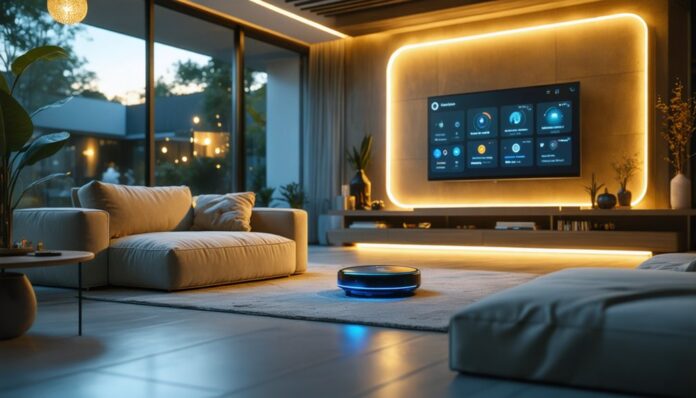

Smart homes in 2026 operate less like collections of gadgets and more like coordinated systems. Sensors, AI, and cross-brand protocols now work together to anticipate needs before a single command is given. Energy, security, and comfort are managed in the background—continuously and quietly. Understanding how these systems actually function reveals something more significant than convenience. The full picture is worth examining closely.
Key Takeaways
- AI-driven anticipatory routines now respond to occupant behavior and schedules, with thermostats pre-conditioning rooms up to 20 minutes before arrival.
- Habit clustering analyzes behavioral data across devices to identify recurring patterns and embed them into automated protocols automatically.
- mmWave radar sensors detect stationary presence, breathing, and minor movements up to 20 feet, enabling smarter occupancy-based automation.
- The Matter protocol, backed by 550+ companies, ensures seamless cross-brand device compatibility, eliminating proprietary limitations and dedicated hardware bridges.
- Local-first AI processes commands and behavioral patterns within the home network, maintaining 99.2% uptime without relying on cloud infrastructure.
What Does a Fully Automated Smart Home Look Like in 2026?
The fully automated smart home of 2026 bears little resemblance to the voice-commanded novelty systems of a decade prior. Today’s integrated environments operate through anticipatory routines that respond to occupant behavior, schedules, and context rather than isolated commands. Thermostats pre-condition rooms up to 20 minutes before arrival. Lighting adjusts automatically based on time of day and activity. AI simultaneously processes dozens of data points, including sleep patterns and daily routines, to enable deep occupant personalization without requiring manual input.
Multi-system hubs unify lighting, climate, security, and window shades under single interfaces spanning multiple brands. Energy systems reduce utility costs up to 30% through intelligent scheduling and occupancy-based operation. Robotic systems handle vacuuming, lawn maintenance, and laundry autonomously, reflecting a home that works invisibly around its occupants. The Matter protocol, backed by over 550 companies worldwide, ensures that devices from different manufacturers connect and communicate seamlessly within a single unified ecosystem.
How Matter Protocol Finally Killed Smart Home Walled Gardens
Beneath the seamless automation defining modern smart homes lies an infrastructure problem that plagued the industry for years: incompatible platforms, proprietary ecosystems, and devices that refused to communicate across manufacturer boundaries.
Released in October 2022 by the Connectivity Standards Alliance, Matter resolved this through open ecosystems uniting over 200 manufacturers, including Apple, Google, Samsung, and LG, under a single certified standard. Bridgeless integration eliminated proprietary solutions like dedicated hardware bridges previously required for limited cross-device functionality. Certified interoperability guarantees every Matter-badged device meets verified compatibility standards, removing consumer guesswork entirely. Local-first control allows smart home systems to operate independently of cloud infrastructure, maintaining full functionality during internet outages. Matter 1.4 further expands capabilities, adding energy management support for solar panels, batteries, heat pumps, and water heaters. Matter devices communicate over Thread network protocol, enabling reliable, low-power mesh connectivity between devices without depending on cloud infrastructure.
How AI Reads Your Intentions Instead of Waiting for Commands
Anticipating user needs before commands are issued, modern AI-driven smart home systems have shifted from reactive to predictive operation, interpreting behavioral signals across interconnected IoT devices to develop situational awareness of household routines.
Machine learning models detect micro-patterns—blinds lowering at sunset, lighting dimming before sleep—translating implicit intent into autonomous environmental adjustments. These predictive nudges extend beyond lighting; thermostats pre-adjust ahead of utility tariff changes while HVAC systems forecast heat and cool curves from historical usage data.
Clustering algorithms categorize behavioral patterns, enabling systems to anticipate contextual needs without user intervention. Reinforcement learning continuously refines accuracy as household routines evolve, incorporating external variables like weather conditions.
The result is an environment that responds to who residents are, not merely what they say. Global AI smart home market revenue is projected to rise from $174 billion in 2025 to over $250 billion by 2029, reflecting accelerating demand for systems that manage themselves autonomously.
How Smart Homes Learn Your Daily Routine Without Being Asked?
Quietly operating in the background, smart home systems build an understanding of household routines by continuously collecting and analyzing behavioral data across interconnected devices without requiring explicit user instruction. Through habit clustering, systems identify recurring behavioral sequences — consistent wake times, cleaning cycles, and temperature preferences — embedding these patterns directly into automation protocols. Thermostats learn preferred settings proactively, while robotic cleaners follow schedules refined through repeated observation.
Implicit triggers further advance this learning process, as motion sensors, smart locks, and device-specific interactions generate contextual data that refines system responses over time. Rather than waiting for commands, systems develop an anticipatory understanding of occupant needs. Weekday and weekend schedules receive differentiated treatment, ensuring automation aligns precisely with the natural rhythm of each household.
Personalized routines handle repetitive household tasks autonomously, freeing occupants to focus on preferred activities without the burden of manual management.
Why mmWave Sensors Are Replacing Every Motion Detector in Your Home
As smart home systems grow more capable of recognizing occupant behavior, the sensors underpinning that awareness become the limiting factor in what automation can actually achieve.
Traditional PIR sensors detect only large movements by tracking heat changes, missing seated occupants entirely.
mmWave radar technology, operating between 30–300 GHz, identifies breathing, minor body shifts, and stationary presence across zones up to 20 feet away.
Unlike PIR, mmWave sensors detect presence through clear glass and distinguish sleeping individuals from empty rooms.
Privacy concerns remain manageable since these sensors collect positional data rather than images or audio.
For installation tips, zone-based models integrate with Apple Home, Home Assistant, and SmartThings via Matter or Zigbee hubs.
Pricing now starts under $20, removing cost as a barrier to adoption. DIY builds using an LD2410 sensor paired with an ESP32 or ESP8266 microcontroller bring total component costs to under ten dollars.
How Local AI Keeps Your Smart Home Private Without Cloud Dependency
Beyond the reach of external servers, local AI processes every command, behavioral pattern, and camera feed entirely within the home network, eliminating third-party exposure by design. Edge privacy architecture guarantees voice data, daily routines, and device usage remain under local encryption, never transmitted to outside infrastructure.
Communities adopting local AI systems benefit from measurable reliability advantages. A 2023 Open Source Home Automation Foundation study confirmed 99.2% uptime for locally hosted voice agents compared to 92.7% for cloud-dependent systems. Responses are instantaneous, unaffected by server processing delays or variable internet latency.
Cost structures also favor local deployment. One-time setup eliminates recurring API fees, subscription dependencies, and vendor lock-in. Complete ownership over security architecture reduces exposure to third-party breaches, positioning local AI as a trusted, permanent foundation for automated home environments. No subscription fees apply, meaning households pay once and retain full access to their automation system indefinitely.
Which Smart Home Automations Actually Save Money in 2026?
Not all smart home technologies deliver equal financial returns, yet certain automations have proven consistently cost-effective heading into 2026. Smart thermostats remain standout performers, with models ranging from $50 to $200 and thermostat rebates frequently available through utility providers. Geofencing and occupancy-based scheduling reduce unnecessary energy consumption automatically. Smart plugs, priced between $10 and $25, enable appliance scheduling for high-consumption devices, delivering immediate returns on frequently used household items. Smart lighting automation reduces costs further by integrating daylight sensors and coordinated shade control to minimize manual intervention. Holistic energy management systems combining thermostats, automated lighting, and efficient appliances achieve 20–30% consumption reductions. Communities adopting these coordinated systems share measurable environmental and financial benefits, making strategic automation accessible across various household budgets. Devices carrying the Matter logo ensure cross-brand compatibility across major ecosystems, reducing the risk of costly replacements when switching platforms or expanding a smart home setup.
How Dynamic Energy Pricing Turns Your Smart Home Into a Self-Managing System
Dynamic energy pricing transforms smart homes into self-regulating systems by connecting household devices directly to live electricity market signals. Through platforms like EPEX Spot, hourly prices fluctuate based on grid supply and demand, enabling dynamic tariffs to guide when appliances operate. Water heaters, EV chargers, and home batteries automatically shift consumption toward low-cost windows, including periods of negative pricing during surplus renewable generation. This automated arbitrage eliminates manual intervention entirely.
Day-ahead price visibility allows Home Assistant and similar platforms to pre-schedule thermostats, pool pumps, and storage systems before expensive periods arrive. When solar generation combines with cheap market hours, savings compound further. Research across ComEd’s 3.5 million residential service region confirms welfare improvements scale proportionally as smart device deployment increases throughout participating communities. Under dynamic pricing, equilibrium prices reflect expected marginal supply costs, ensuring households pay rates that accurately mirror real-time grid conditions.
How Smart Glass and Solar Are Pushing Homes Toward Zero Energy Waste
Alongside dynamic pricing automation, smart glass and integrated solar technologies are eliminating another major source of residential energy waste: uncontrolled solar heat gain and excessive reliance on artificial lighting. Electrochromic glass blocks up to 90% of solar radiation at peak states, reducing HVAC peak loads by 23–30% while lowering overall energy consumption by 20%.
Glare management algorithms precisely regulate sunlight penetration, preserving natural light without overheating interiors or triggering unnecessary artificial illumination. Solar harvesting façades combining photovoltaic cladding with ultra-low reflectance smart glass generate clean electricity that can directly power smart glass systems, reducing grid dependency.
Cumulatively, these technologies deliver up to 40% energy cost reductions, with commercial benchmarks like the Empire State Building confirming $2.4 million in verified annual savings following installation. Smart glass systems are also compatible with leading smart automation platforms such as Alexa, Control4, and Lutron, enabling automatic adjustments based on sunlight levels, time of day, or occupancy to ensure energy is consumed only when necessary.
How Smart Home Security Works Without Cameras or Compromised Data
Energy efficiency innovations have reshaped how homes manage power consumption, but automation in residential environments extends beyond resource management into physical security—specifically, systems designed to detect threats without capturing or storing visual data.
Radio wave technology identifies intruders by measuring Wi-Fi signal disturbances, detecting movement through walls without visual recording. Sensor-based systems combine entry detectors, motion sensors, and AI analysis to distinguish people from animals or packages, delivering push, email, or SMS alerts instantly.
Local authentication keeps data processing within the home network, eliminating third-party exposure risks. Self-monitored configurations remove monthly fees and intermediary call centers, while DIY installation requires no technician involvement. Contract-free ownership models allow residents to configure, adjust, and manage security independently—maintaining full control without surrendering personal data to external platforms. Leading self-monitored systems have been evaluated across more than 30 security systems, with SimpliSafe earning a 9.2 SecureScore and ranking as the top no-contract option for 2026.
The Background Systems Running Your Smart Home Without You Noticing
Beneath the surface of a functioning smart home, a layered infrastructure of AI engines, distributed sensors, and communication protocols operates continuously—anticipating needs, monitoring conditions, and coordinating devices without requiring resident input. This silent orchestration runs through standardized communication channels including Wi-Fi, Zigbee, and Z-Wave, unified under centralized hub platforms coordinating lighting, HVAC, security, and entertainment simultaneously.
Machine learning algorithms analyze daily routines, optimizing settings automatically while predictive maintenance tracks appliance parameters to identify failure risks before they materialize.
The sensor choreography extends across CO2, PM2.5, and mmWave presence detectors, all feeding real-time data into local processing platforms like Home Assistant. By executing automations locally rather than through cloud dependency, these systems achieve instantaneous responses while maintaining privacy—functioning reliably whether residents are present or not. Computer vision layers add further intelligence, enabling systems to distinguish pets from humans and trigger targeted responses such as activating outdoor lights or recording footage only when unknown visitors are detected.
How Close Are We to Smart Homes That Genuinely Run Themselves?
Despite meaningful advances in AI-driven automation, smart homes have not yet reached genuine autonomy. Researchers acknowledge current progress as advanced while identifying device synchronization across connected ecosystems as a critical remaining barrier.
Behavioral forecasting capabilities are strengthening, with machine learning systems adjusting settings based on detected occupant patterns without requiring manual direction. Context fusion — combining occupancy detection, energy data, and personalized preferences — is enabling increasingly seamless environmental responses. Demonstrations like the Duet system achieved 96% occupant identification accuracy, triggering automatic adjustments without residents carrying devices. Autonomous energy management through integrated HVAC and smart meter systems further reduces human intervention.
Experts project widespread availability of genuinely self-managing AI-driven features within five years, contingent on foundational network infrastructure upgrades supporting fully scaled autonomous operation. Systems like Duet are also designed with explicit consent mechanisms, allowing residents to grant or revoke access through a dedicated app.
In Conclusion
The fully automated smart home is no longer a distant concept—it is an actively developing reality shaped by converging technologies. AI-driven learning, cross-platform interoperability, advanced sensing, and local processing are collectively removing friction from household management. Progress remains uneven across regions and income levels, and genuine full autonomy presents remaining technical and ethical challenges. However, the foundational infrastructure is largely in place, and the trajectory toward self-managing homes continues accelerating with each successive generation of integrated devices.
References
- https://www.repenic.com/blogs/knowledge/smart-living-ultimate-guide-to-modern-home-automation-2026
- https://ciobulletin.com/automation/top-five-best-smart-home-technologies-in-2026
- https://www.youtube.com/watch?v=XsC_NnTBDb0
- https://www.sourceready.com/report/detail/us-smart-home-market-report-2026
- https://www.seacomp.com/resources/smart-home-automation-trends-and-innovations-what-device-manufacturers-need-to-get-right
- https://www.taichuansmart.com/blog/best-smart-home-devices-2026/
- https://spartanconcepts.ai/the-complete-guide-to-smart-home-automation-in-2026/
- https://www.youtube.com/watch?v=t_IIP90ixKE
- https://quantum-av.com/blog/the-latest-home-automation-trends-shaping-smart-homes-in-2026
- https://www.brilliant.tech/blogs/news/brilliant-s-smart-home-trends-for-2026