

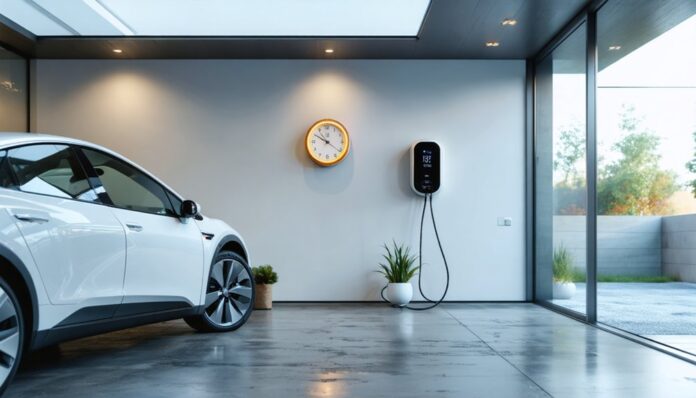

Home EV charger costs typically fall between $800 and $3,000, with a common price of around $2,100 for a professionally installed Level 2 unit in 2025. The total includes hardware ($400‑$1,200), labor ($200‑$3,000), permits ($100‑$300), and materials such as wiring and mounting. A 40 A circuit usually suffices for overnight charging, but longer runs or panel upgrades can push costs above $5,000. Federal tax credits cover 30 % of equipment and installation, up to $1,000, and utility rebates may further reduce expenses. Detailed breakdowns and savings calculations await.
Key Takeaways
- Home EV charger installation typically costs $800–$3,000, with a common price around $2,100 for a professionally installed Level 2 unit.
- Total cost breaks down into labor ($200–$3,000), permits ($100–$300), materials ($300–$1,500), and possible panel upgrades, which can push expenses above $5,000.
- A simple plug‑in installation is sufficient if the existing panel has a free 40 A or 50 A double‑pole breaker and adequate capacity for overnight charging.
- Federal tax credit covers 30% of equipment and installation up to $1,000; combine with utility rebates for additional savings.
- Home electricity ($0.11–$0.18/kWh) yields per‑mile costs of about $0.05, saving $270–$1,117 annually compared to public Level 2 or DC fast charging.
How Much Does a Basic Home EV Charger Actually Cost?
A basic home EV charger typically costs between $800 and $3,000 total, encompassing hardware, labor, and permits, with the most common price point hovering around $2,100 for a professionally installed Level 2 unit in 2025.
The hardware segment ranges from $400 to $1,200, with smart 48‑amp models at the higher end and basic 32‑amp units near $300‑$600. Labor and permits add $400‑$1,200, varying by wiring complexity and local code requirements.
When selecting a unit, charger aesthetics matter; sleek, low‑profile designs integrate smoothly into garage décor, reinforcing a sense of community belonging among environmentally conscious neighbors.
Ownership transfer considerations also arise, as resale value can improve when a well‑maintained, visually appealing charger is documented as part of the property’s upgrades. Panel upgrades can future‑proof the home for additional electrification needs. Level 2 chargers add about 20–40 miles of range per hour. Predictable costs in 2026 make now an ideal time to invest.
What Components Make Up the Total Home EV Charger Installation Cost?
Beyond the charger’s price tag, the total installation cost breaks down into four primary components: labor, permitting and regulatory fees, electrical materials and equipment, and any necessary electrical panel upgrades, each driven by distance and installation complexity.
Labor ranges from $200 to $1,000 for simple 240‑volt outlets, rising to $2,500–$3,000 for long runs, trenching, or panel upgrades; California sites often exceed $1,400 per charger. Permits typically cost $100–$300, with higher fees for hard‑wired or remodel projects.
Materials—including mounting hardware, NEMA 14‑50 outlets, and wiring—run $300–$800, plus $10–$20 per foot for trenching; long cable runs add $1,000–$1,500.
Panel upgrades, when required, can push total costs above $5,000. Understanding these elements streamlines the installation timeline and informs a thorough maintenance checklist for homeowners. Licensed electrician should perform an EV charger load calculation prior to electrical work. Federal tax credits can reduce overall expenses by up to 30 %. Tasker assistance can help with permitting and code compliance.
When Is a Simple Plug‑In EV Charger Installation Enough?
Determine whether a simple plug‑in EV charger suffices by evaluating the home’s existing electrical capacity, panel slot availability, and the driver’s daily mileage needs; if a dedicated 40 A or 50 A double‑pole breaker can be added without a panel upgrade, the space permits a NEMA 14‑50 outlet within 18–24 inches of the floor, and the vehicle’s charging demand does not exceed 40 A, a plug‑in installation provides a safe, code‑compliant solution. This approach suits households with a single EV and moderate daily trips, where the electrician can install a dedicated outlet while preserving outlet aesthetics. It also fits temporary rentals, allowing owners to add a compliant charger without permanent wiring. The process requires a permit, proper mounting height, and a post‑install test to confirm voltage and amperage. Installation requires a permit, proper mounting height, and a post‑install test to confirm voltage and amperage. ADA compliance can be ensured by maintaining a clear 36‑inch pathway around the charger. NEC Article 625 mandates a dedicated branch circuit for EVSE to ensure safety and code compliance.
Which EV Charger Model Gives the Best Value for Your Money?
Choosing the most cost‑effective EV charger requires balancing upfront price, power output, smart‑load features, warranty length, and connector compatibility.
The Grizzl‑E Ultimate 48A delivers 48 A for $480, offering the best Grizzl E value among high‑output units while supporting J1772 and NACS.
Emporia Pro adds PowerSmart load management, enabling Emporia savings by avoiding panel upgrades and optimizing off‑peak charging.
For tighter budgets, the Lectron Portable Level 2 at $280 provides solid performance, though without advanced load control.
Autel MaxiCharger AC Lite 40A, discounted to $319, combines 40 A output with a 3‑year warranty, while the EVIQO EV Charger, regularly $345.95, adds smart features at a competitive price.
A 40A circuit is typically adequate for overnight charging for most EVs.
When Do You Need a Sub‑Panel or Major Panel Upgrade for Your Home EV Charger?
The best‑value chargers previously examined often require a dedicated 40‑60 A 240 V circuit, which can expose limitations in a home’s electrical service. A professional load calculation determines whether the existing panel can accommodate the extra 30‑50 A demand without compromising panel lifespan.
If the main panel is 200 A and has complimentary double‑pole slots, a sub‑panel may be added to host the EV circuit while preserving space for future loads. Conversely, a 100‑A panel that regularly trips breakers, shows flickering lights, or has no available slots indicates the need for a major upgrade to a 200‑A service.
Smart load monitoring can defer costly upgrades, but when capacity is exhausted, replacing the panel guarantees safety, reliability, and long‑term durability.
How Does Distance From the Main Panel Impact Wiring Costs for an EV Charger?
From the main panel to the charging location, each foot of distance adds material and labor costs, making proximity a primary factor in the overall price of an EV‑charger installation.
Panel proximity determines whether a job is classified as simple, typical, or complex; a garage adjacent to the panel often falls in the $300–$800 range, while a driveway several meters away can push total expenses beyond $2,500.
Wiring costs rise $10–$20 per foot, and trenching costs for underground conduit add several hundred dollars depending on depth and length.
Longer runs require additional copper, conduit, and wall or ceiling penetrations, increasing labor hours and material fees. Consequently, each extra foot amplifies both material and labor, making distance a decisive cost driver.
Which Federal Tax Credits and Utility Incentives Can Slash Your Home EV Charger Bill?
How much can a homeowner reduce the out‑of‑pocket cost of an EV charger? The 30C federal tax credit covers 30 % of equipment and installation, up to $1,000, when claimed on IRS Form 8911 for a charger placed in service by June 30 2026. Eligibility includes primary residences in low‑income census tracts, and the credit applies to Level 2 units that meet DOE standards.
In parallel, many utility companies provide rebates that can further lower expenses; these utility rebates often target low‑income eligibility zones and may stack with the federal credit.
Homeowners should verify local program criteria online, retain purchase and installation documentation, and file the credit in the year the charger becomes operational to maximize savings.
How to Calculate Real‑World Savings of Your EV Charger vs. Public Charging?
A typical EV owner can quantify real‑world savings by comparing the cost per kilowatt‑hour required to charge the vehicle at home versus at public stations and then translating that differential into per‑mile and annual expenses. Home rates of $0.11‑$0.18/kWh contrast with public Level 2 ($0.25‑$0.37/kWh) and DC fast ($0.47‑$0.70/kWh), yielding per‑mile costs of roughly $0.05 versus 0.13.
For a 13,489‑mile year, home charging costs about $694, while Level 2 and fast public charging rise to $964 and $1,811 respectively—savings of $270‑$1,117. Drivers can model these gaps using vehicle efficiency (kWh/mi) and annual mileage, then adjust for behavioral charging patterns and real‑world emissions to reinforce community‑wide cost‑effectiveness.
References
- https://getneocharge.com/a/blog/how-much-does-it-cost-to-install-a-home-charging-station
- https://qmerit.com/blog/understanding-your-ev-home-charging-station-costs-for-installation/
- https://recharged.com/articles/how-much-does-home-ev-charger-installation-cost
- https://evchargeright.com/blog/ev-charger-installation-cost
- https://www.energysage.com/ev-charging/how-much-does-ev-charger-installation-cost/
- https://simpleswitch.io/cost-of-installing-ev-charger-at-home/
- https://bryanhindmanelectric.com/blog/ev-charger-installation-cost
- https://homebattery.ecoflow.com/us/blog/level-2-charger-installation-cost
- https://pierelectric.com/florida-ev-charger-costs/
- https://ev-lectron.com/blogs/blog/best-home-ev-charger-2025-2026-complete-buying-installation-and-cost-guide