

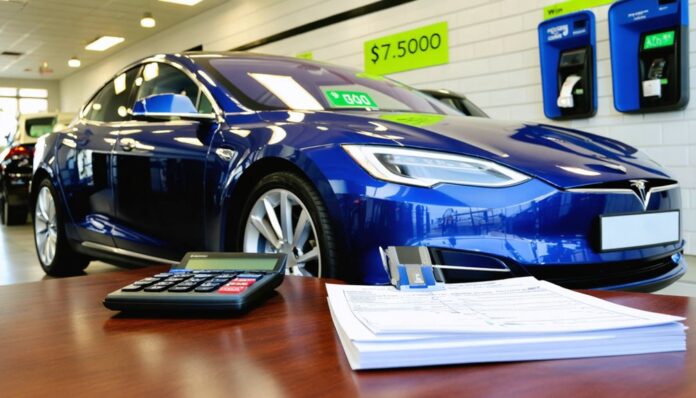

The $7,500 federal EV tax credit created a deadline‑driven buying rush, spurring a 21 % sales surge in the quarter ending September 30 2025 and prompting dealers to use countdown clocks and targeted outreach. When the credit expired, average EV prices rose 18 % and lease share fell from 58 % to under 30 %, while consumers shifted toward hybrids and used EVs to avoid higher costs. State rebates in Connecticut and Ohio softened the impact, but market dynamics changed sharply. Continued analysis reveals deeper insights into post‑credit consumer behavior.
Key Takeaways
- Federal EV tax credits create a “deadline effect,” prompting buyers to purchase before expiration, which spikes sales near the cut‑off date.
- The credit effectively reduces vehicle price (e.g., $7,500 ≈ 13% discount), making EVs more price‑competitive with gasoline cars.
- When the credit expires, EV prices rise (average 18% increase), shifting demand toward cheaper hybrids and used EVs.
- Lease incentives and dealer cash‑backs often replace the credit, but declining lease share and higher residual risk reduce lease attractiveness.
- State and local rebates offset federal credit loss, preserving affordability and sustaining EV demand in specific markets.
How Did the $7,500 Federal Credit Influence When Buyers Purchased EVs?
By the end of September 2025, the looming expiration of the $7,500 federal EV tax credit created a pronounced “deadline effect” that reshaped purchase timing across the market. Data show a 21 % surge in EV sales in the quarter ending September 30, with August new‑vehicle volumes up 17.7 % YoY and used EVs up 59 % YoY.
Dealer marketing amplified tax timing urgency: countdown clocks on Chevrolet and Ford sites, targeted email blasts, and in‑showroom signage highlighted the September 30 cut‑off. Buyers rushed to lock contracts and payments before the deadline, reducing average used‑EV lot time to 46 days—30 % shorter than the prior year.
The coordinated push generated the projected biggest sales month of September 2025, confirming that deadline‑driven incentives can synchronize consumer behavior and dealer strategy. Tariff costs added approximately $5,500 to the price of imported EVs, further intensifying buyer urgency. Record‑high sales underscore the impact of the credit expiration on market dynamics. California’s $1.1 billion share of total credits highlights the state’s leading role in EV adoption.
Why Did EV Prices Jump 18% After the Credit Disappeared?
The surge of purchases that peaked in August 2025 created a sharp contraction in demand once the $7,500 federal EV tax credit expired, and the resulting loss of an effective discount translated directly into higher transaction prices. Data show an 18 % price shock as the $7,500 credit, previously a 13 % discount on the $57,245 average new‑EV price, vanished. The abrupt end of the credit eliminated the demand pull‑forward that had accelerated buying, causing a sudden dip in orders and allowing manufacturers to raise sticker prices without offsetting incentives. Automakers, weighing production constraints, opted for modest cash‑back offers rather than deep cuts, reinforcing the upward price trajectory. Consequently, real‑term EV prices rose, reflecting both the discount loss and the market’s adjustment to a post‑credit environment. 65% of prospective EV buyers still intend to purchase within two years even without the credit. The EV charging equipment credit remains available for purchases made by June 30, 2026, offering up to $1,000 or 30 % of qualifying costs. Tesla’s ability to leverage manufacturing efficiencies could enable price cuts despite the credit loss.
What Caused the Sharp Decline in EV Lease Usage?
Seventy‑one percent of recent EV sales were leases, a share sustained by the Commercial Clean Vehicle Credit that allowed leased vehicles to qualify for the $7,500 federal incentive regardless of manufacturing origin. The credit’s termination under the One Big Beautiful Bill Act removed the financial edge that had driven high lease churn, exposing residual risk that finance firms could no longer absorb. Data from Experian show the lease share fell from 58 % in Q2 2025 to under 30 % by Q1 2026, while J.D. Power reports off‑lease inventory surging 200 % to 330 000 units in 2026. Accelerated depreciation—actual 35‑40 % retention versus the assumed 50 %—further eroded profitability, prompting lenders to tighten lease approvals. Consequently, consumers gravitated toward used EVs, where lower prices and stable battery warranties mitigated the perceived risk and reinforced community confidence in sustainable mobility. The 13‑day supply of new EV inventory in Q1 2026 further pressured manufacturers to increase incentives. The rising tariff‑caused inflation has also contributed to higher new‑vehicle prices, making used EVs an increasingly attractive option. The large influx of 2022‑2023 model EVs with low mileage and remaining battery warranties is set to expand the used‑EV market further.
What State Incentives (OBBBA, CT CHEAPR) Are Replacing the Federal EV Credit?
Following the September 2025 expiration of the federal EV tax credit, state programs such as Connecticut’s Hydrogen and Electric Automobile Purchase Rebate (CHEAPR) and the Ohio “One‑Time Battery‑Buy‑Back Assistance” (OBBBA) have emerged as the primary financial levers sustaining consumer adoption.
CHEAPR, administered by DEEP, allocates $13 million to point‑of‑sale rebates, raising the standard BEV rebate to $1,000 and offering a Rebate+ voucher of $3,000 for income‑qualified residents.
OBBBA mirrors this approach with a one‑time cash assistance tied to battery purchase price, targeting Ohio drivers who meet income thresholds.
Both initiatives operate on a first‑come, first‑served basis, cap eligibility at $50,000 MSRP, and integrate directly into dealer invoices, preserving affordability and reinforcing community confidence in electric mobility. The Norwich Public Utilities vehicle rebates provide an additional $1,500 for new EVs, further expanding state‑level incentives.
Which EV Brands Won or Lost After the Credit Ended?
State‑level rebates such as Connecticut’s CHEAPR and Ohio’s OBBBA have softened the impact of the federal credit’s disappearance, but the market data reveal a clear reallocation of demand among manufacturers.
Tesla gains are unmistakable: U.S. EV share surged from 41 % in Q3 2025 to 59 % in Q4 2025, the highest since 2023, with the Model Y and Model 3 each topping 10,000 units. Cadillac rebounds, contributing to GM’s 10.8 % EV share in Q4 2025 and ranking among only four brands with year‑over‑year growth. Volvo and Jeep similarly posted gains, while legacy players such as Ford, Hyundai, Volkswagen and Mercedes‑Benz experienced double‑digit declines, underscoring a market pivot toward a few resilient marques.
What Do Consumers Prioritize Now in the Post‑Credit EV Market?
Why do consumers now prioritize certain attributes over federal incentives? In the post‑credit market, buyers gravitate toward tangible ownership benefits. Data show that regions with robust charging access experience a 40 % higher EV preference, while 85 % of consumers cite improved networks as confidence‑boosting.
Battery longevity remains a decisive factor; 30 % of potential buyers cite durability concerns, yet 75 % are attracted to rapid battery‑tech advancements that promise extended range.
Cost calculus has shifted: high upfront prices dominate, yet 46 % are motivated by lower running costs and 30 % seek long‑term value stability.
Environmental identity fuels community, with over 80 % prioritizing carbon‑reduction. Together, these metrics illustrate a collective move toward practical, reliable, and eco‑conscious mobility.
Why Hybrids Became Popular After EV Incentives Ended?
A pronounced shift in market dynamics emerged as the $7,500 federal EV credit expired on September 30 2025, prompting consumers to gravitate toward hybrids whose sales share rose 1.4 percentage points to 14.7 % while overall EV market share fell below 8 % in January 2026.
The post‑expiry environment highlighted fuel economy and cost savings as decisive factors; hybrids delivered electric‑assist efficiency without the premium price jump that lifted average EV cost 18 % to $51,981. Dealer incentives rose to $3,004 per vehicle, narrowing the gap with gasoline models and reinforcing mainstream appeal. Data from Carfax showed a 30 % acceleration in hybrid purchases as the credit deadline approached, confirming that buyers sought familiar combustion platforms combined with modest electric benefits, fostering a sense of community around pragmatic, budget‑conscious mobility.
What Is the Forecast for EV Sales Through 2027?
Nearly half a million electric vehicles are expected to roll off U.S. dealer lots each year by 2027, pushing total annual sales to roughly 4.5 million units and lifting EVs to about one‑third of all new car purchases. The projection rests on sustained tax incentives, affordable model rollouts, and a projected decline in battery costs that will undercut gasoline cars by 2027.
EV adoption is projected to rise from 10 % in 2023 to 33 % by 2027, positioning the United States for a 48 % share by 2030. Parallel growth in charging infrastructure—particularly the EU’s 80 % highway coverage and expanding U.S. networks—reinforces consumer confidence and accelerates market penetration.
Global trends show a 21 % annual growth rate, with Europe and China already surpassing U.S. momentum, underscoring the importance of coordinated policy and infrastructure investment.
References
- https://www.mensjournal.com/news/ev-sales-just-crashed-after-the-7500-tax-credit-disappeared
- https://www.carscoops.com/2026/03/us-ev-sales-tax-credit-impact/
- https://www.youtube.com/watch?v=lBE4Z-pRWpg
- https://www.cleanenergycu.org/resources/blog/obbba-ev-tax-deduction-2026-guide/
- https://evclubct.com/all-the-incentive-changes-going-into-2026/
- https://www.kbb.com/car-advice/used-electric-car-tax-credits-explained/
- https://afdc.energy.gov/laws/electric-vehicles-for-tax-credit
- https://www.caranddriver.com/news/a70020914/why-2026-will-be-a-great-time-to-buy-a-used-ev/
- https://www.cars.com/articles/electrification-interrupted-as-ev-incentives-sunset-hybrids-emerge-as-the-smart-middle-ground-for-2026-521084/
- https://www.ttnews.com/articles/ev-sales-surged-tax-credit