

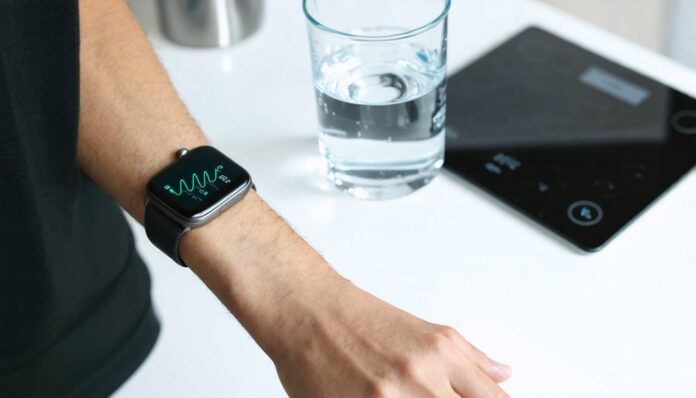

Wearable devices capture health trends by continuously sampling physiological signals—ECG electrodes record cardiac electrical waveforms, PPG optics detect blood‑volume pulses, IMUs measure motion and respiration, and thermoelectric sensors track skin temperature. Signal pipelines filter motion artifacts, normalize amplitudes, and fuse data streams to produce unified metrics such as heart‑rate variability, respiratory rate, and SpO₂. AI‑driven models analyze these metrics, distinguishing stress from exertion, forecasting disease risk, and triggering micro‑interventions. Continued exploration reveals deeper insights into clinical validation and predictive health applications.
Key Takeaways
- Wearables capture continuous physiological streams—ECG, PPG, IMU, temperature, SpO₂—at second‑by‑second to multi‑second cadences for real‑time trend analysis.
- Preprocessing pipelines filter motion artifacts, normalize amplitudes, and fuse multi‑sensor data to generate clean heart‑rate, respiration, and activity metrics.
- AI‑driven sensor fusion and digital‑twin models predict stress, hypertension, diabetes, and cardiac events with up to 96% accuracy, enabling micro‑interventions.
- HRV, derived from ECG/PPG, serves as a primary biomarker for autonomic balance, stress detection, and early disease risk assessment.
- Integrated RPM platforms stream these validated metrics to EHRs, allowing clinicians to monitor trends, detect infections, and support remote care decisions.
Wearable Health Monitoring: Core Vital‑Capture Techniques
Through a combination of electrophysiological and photoplethysmographic sensors, modern wearables capture heart rate with high fidelity; ECG electrodes record the cardiac electrical waveform, while optical modules detect blood‑volume changes in the dermis. Sensor fusion integrates these streams, allowing algorithms to reconcile electrical and optical data into a unified pulse waveform.
Signal preprocessing removes motion artifacts, applies band‑pass filtering, and normalizes amplitude before heart‑rate extraction. Parallelly, inertial measurement units and temperature probes contribute respiratory, temperature, and posture metrics, each subjected to dedicated preprocessing pipelines that mitigate drift and noise.
Continuous sampling—ranging from second‑by‑second to eight‑second intervals—enables real‑time trend analysis, fostering a sense of shared vigilance among users and clinicians alike.
Outpatient wireless monitoring mitigates hospital bed scarcity by allowing patients to be safely observed at home. Wearable health devices also support patient empowerment by placing individuals at the center of their own healthcare management.
Wearable Health Monitoring: Accuracy & Clinical Validation of Sensors
The high‑fidelity signals captured by electrophysiological and photoplethysmographic sensors must be rigorously evaluated before they can inform clinical decisions. A three‑stage sensor validation framework—V1 verification, V2 analytical validation, and V3 clinical validation—provides a systematic path from raw measurement to population‑specific analytics and therapeutic relevance.
In gait accuracy studies, young adults reach 95 % precision at 1000 Hz sampling, while older cohorts show a 6.45 % swing‑time improvement and >98 % slip/trip classification (P < .05). Machine‑learning augmentation lifts center‑of‑pressure prediction by over 30 %, and fall‑risk AUROC of 0.919 rivals traditional POMA and TUG scores.
Disease‑specific evidence, such as Parkinson’s gait differentiation and diabetes forefoot pressure reductions, further underscores the necessity of robust validation before clinical integration. Sensor selection must consider both medical‑grade and consumer devices to ensure fit‑for‑purpose data capture. Standardized protocols are essential for reproducible, across diverse cohorts. The study demonstrated a 99 % accuracy in distinguishing sedentary from ambulatory activity using MAD cut‑point derived from chest‑worn ECG patches.
HRV as an Early‑Illness Indicator
In recent years, heart‑rate variability (HRV) has emerged as a sensitive, non‑invasive marker of early autonomic dysfunction, offering clinicians a window into the physiological disturbances that precede overt disease.
Low HRV, reflected by reduced SDNN and RMSSD, signals sympathetic dominance and diminished parasympathetic tone, which precede metabolic and vascular changes.
Studies in young adults with metabolic syndrome show LF and HF declines of 27 % and 38 % respectively, while the LF/HF ratio rises, underscoring HRV’s role in metabolic screening.
Prospective data link a 1 % SDNN increase to a 1 % reduction in cardiovascular risk, and meta‑analyses confirm a 40 % higher event rate with low HRV.
Consequently, wearable‑derived HRV enables rapid autonomic screening, supporting early intervention before clinical disease manifests.
The study found a strong inverse correlation between waist circumference and HRV indices, highlighting abdominal adiposity as a key driver of autonomic imbalance.
Reduced HRV is also a recognized predictor of sudden cardiac death, especially in young athletes with undiagnosed cardiac abnormalities.ANS activity can be directly inferred from HRV patterns, providing insight into the balance between sympathetic and parasympathetic influences.
What Your Breathing Rate and SpO₂ Tell You About Your Health?
Heart‑rate variability has shown how subtle autonomic shifts precede overt disease; similarly, respiratory dynamics and peripheral oxygen saturation (SpO₂) provide immediate insight into pulmonary function and systemic oxygen delivery. A wearable that records resting respiratory rate and oxygen saturation can flag early physiologic stress. Normal adult ranges cluster around 12‑20 breaths per minute, with a median of 15.8 brpm; values above 20 brpm (tachypnea) often signal COPD, obesity, diabetes, or acute stress, while below 12 brpm (bradypnea) may indicate central nervous system compromise or drug effect. Elevated respiratory rate is associated with higher odds of abdominal obesity, diabetes, and current smoking in community‑dwelling adults. Concurrent SpO₂ trends reveal whether oxygen delivery matches demand; persistent desaturation despite normal ventilation suggests ventilation‑perfusion mismatch or cardiac limitation. Integrated alerts encourage users to seek assessment, fostering proactive health stewardship within a supportive community.
Detecting Early Infections With Skin‑Temperature & Activity Trends
Monitoring subtle shifts in peripheral skin temperature alongside activity patterns offers a reliable early warning system for infections.
Recent studies demonstrate that wearable skin sensors, employing batteryless thermoelectrics, can detect temperature changes as small as 0.4 °C within three seconds, producing a continuous thermal map that highlights local inflammation.
Low‑cost wrist devices, validated in the IEEE Sensors Journal, correlate slowly‑varying temperature elevations with reduced activity to flag early febrile responses to viral, bacterial, or fungal agents.
Clinical trials using the E4 wristband confirm that temperatures above 37 °C, combined with heart‑rate variability and respiration data, predict infection in kidney‑disease patients hours before clinical diagnosis.
These findings support scalable, community‑wide screening while preserving user comfort and a sense of shared health vigilance.
Ai‑Driven Predictive Health Insights From Multi‑Sensor Data
Harnessing the continuous streams from ECG, PPG, activity, respiration, and temperature sensors, AI algorithms fuse multi‑sensor data to generate predictive health insights with clinical precision. The integrated model filters noise, distinguishes stress from exertion, and extrapolates trends that forecast hypertension, diabetes, or imminent cardiac events with up to 96 % accuracy.
A digital twin, continuously updated by these streams, mirrors the wearer’s physiology, enabling simulation of treatment responses and lifestyle adjustments. Predictive alerts trigger proactive coaching, while medication adherence tools leverage sensor cues to confirm intake, send reminders, and flag potential interactions.
This ecosystem delivers personalized, data‑driven guidance that reinforces community belonging and empowers users to act before symptoms manifest.
From Wristbands to Clinical Remote‑Patient Monitoring
From simple step counters to sophisticated clinical‑grade platforms, wearable devices have rapidly evolved into indispensable tools for remote patient monitoring. Modern smartwatches, biosensors, and smart jewelry now capture oxygen saturation, skin temperature, blood pressure, and ECG data, feeding real‑time streams into integrated RPM platforms such as Biofourmis.
Battery longevity has become a design priority, enabling continuous multi‑day monitoring without frequent charging, while gesture controls simplify user interaction and reduce compliance barriers. Seamless EHR integration and telehealth connectivity allow clinicians to detect arrhythmias, falls, or glucose instability early, prompting preemptive interventions that cut readmissions by up to 50 %.
The market’s 12.7 % CAGR reflects growing trust among physicians and patients, fostering a shared commitment to home‑based, data‑driven care.
Stress, Mood, and HRV: Mental‑Wellness Metrics in Wearables
The evolution from basic activity tracking to clinical‑grade remote monitoring sets the stage for a deeper examination of mental‑wellness metrics, where heart‑rate variability (HRV), electrodermal activity (EDA), and skin temperature converge as primary indicators of stress and mood.
HRV, captured by PPG sensors at 1‑5‑minute intervals, outperforms average heart rate in stress detection, especially when combined with ECG data. Wearables such as Oura Ring, Garmin, and Apple Watch Ultra 2 embed HRV into stress scores, enabling real‑time biofeedback.
Continuous EDA and temperature monitoring enrich the physiological picture; Fitbit Sense 2 leverages GSR for instant stress alerts.
Machine‑learning models synthesize these streams with contextual cues to deliver personalized microinterventions—guided breathing, hydration prompts, or brief mindfulness—fostering a sense of belonging within a supportive digital health ecosystem.
References
- https://www.jointcorp.com/fitness-tracker-market-trends-2026-whats-next-in-wearable-health-technology/
- https://www.smartdatainc.com/knowledge-hub/why-wearable-health-tech-is-booming-in-2026/
- https://scoop.market.us/smart-wearables-statistics/
- https://clutch.co/resources/wearable-technology-trends
- https://vertu.com/guides/top-10-wearable-health-trackers-for-optimal-wellness-in-2026/
- https://doccure.io/best-wearable-devices-for-health-tracking-2026-ai-integration-and-reviews/
- https://www.coherentmarketinsights.com/market-insight/wearable-technology-market-4771
- https://counterpointresearch.com/en/insights/ces-2026-wearables-market-overview
- https://leapsandrebounds.com/blogs/news/top-wearable-fitness-monitor-picks-for-2026-stay-ahead-of-your-health-goals
- https://www.ncbi.nlm.nih.gov/books/NBK599967/