

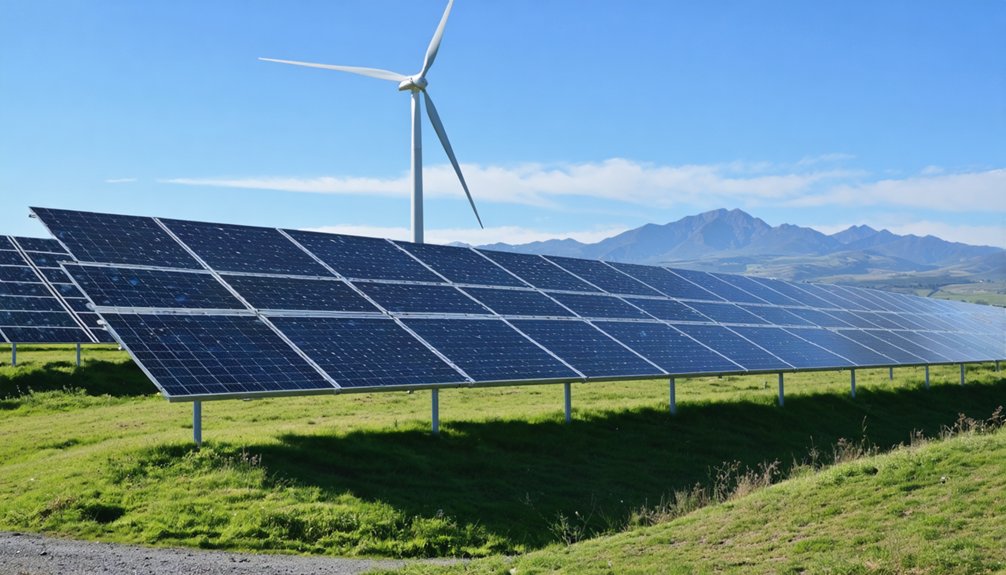

Green technology trims energy use by deploying high‑efficiency hardware, AI‑driven load optimization, and renewable generation that replace wasteful fossil power. Smart thermostats, IoT‑linked storage, and demand‑response platforms shift consumption to off‑peak periods, cutting heating, cooling, and peak‑shifting costs. Falling solar PV prices and cheaper wind turbines lower electricity rates, while liquid‑cooled AI servers and next‑gen chips reduce data‑center power draw. Policy incentives and investor capital accelerate these solutions, and the next sections reveal deeper savings.
Key Takeaways
- Smart thermostats and AI analytics optimize heating, cooling, and load shifting, cutting waste up to 30%.
- LED retrofits and advanced energy management lower operating expenses 20‑40% with 2‑3‑year paybacks.
- Solar PV and wind power costs have fallen dramatically, making renewable generation cheaper than fossil fuels and reducing grid reliance on high‑carbon sources.
- Grid‑scale battery storage enables peak shifting and price‑volatility protection, decreasing household bills by ~21% and overall energy costs by billions.
- Liquid‑cooling and efficient AI chips reduce data‑center power draw 30‑40%, lowering PUE toward 1.2 and curbing growing electricity demand.
Why Green Tech Is Slashing Energy Bills for Homes and Businesses
A growing body of evidence shows that green technology is dramatically lowering energy bills for both residential and commercial users.
Smart thermostats, paired with behavioral nudges, enable occupants to align heating and cooling with actual occupancy patterns, cutting waste by up to 30 %. Integrated AI analytics monitor real‑time demand, prompting users to shift non‑essential loads to off‑peak periods.
In businesses, energy‑efficient systems—LED retrofits and advanced management platforms—deliver 20‑40 % reductions in operating expenses, with payback within two to three years.
Community‑wide adoption reinforces a shared commitment to sustainability, fostering a sense of collective achievement while delivering measurable cost savings across the grid. Circular economy initiatives further amplify these savings by reusing resources and minimizing waste. The rapid deployment of renewable energy and storage in the Global South is driving a soft energy transition that cuts grid capacity costs by roughly half. U.S. retail electricity demand has risen 2 % year‑on‑year in 2025, adding pressure for efficiency‑driven solutions.
How Falling Solar PV Costs Directly Reduce Your Power Bill
Lowering solar‑PV costs translates directly into smaller power bills, as each dollar saved on module pricing and lease rates reduces the amount households and businesses must pay for electricity.
Module prices have plunged over 80 % in the past decade, now ranging between $0.18 and $0.25 per watt, and are projected to keep falling as efficiency improves.
Concurrently, lease savings are emerging: first‑year lease fees dropped from $22/kW‑month in 2025 to an anticipated $18/kW‑month, aided by tax incentives and lower financing rates.
These reductions narrow the gap with rising utility rates, which are forecast to increase 20 % or more by 2028.
Consequently, adopting solar PV yields immediate, measurable bill relief while fostering a community of cost‑conscious, environmentally aligned consumers.
The 2025 solar LCOE rose 6% year‑on‑year due to supply‑chain constraints. Rising electricity rates are expected to climb at ~5 % per year, further strengthening the financial case for solar.
Global solar industry projected to grow 20X by 2050 provides a robust backdrop for continued cost declines.
Why Offshore and Onshore Wind Cut Electricity Costs for Grid Users
Through falling capital and operating expenses, both offshore and onshore wind are reshaping grid economics, delivering measurable reductions in wholesale electricity prices for consumers. Analysts cite a 36 % drop in fixed‑bottom offshore costs—from $95/MWh to $61/MWh by 2035—and a 40 % decline in onshore turbine installation prices, driving offshore savings that cascade to end‑user bills. Learning‑by‑doing and larger turbine efficiencies compress Levelized Cost of Energy to roughly half 2015 forecasts, while the benefit‑to‑cost ratio of 14:1 for offshore farms demonstrates strong economic returns. These cost cuts enable grid operators to lower peak prices, enhance grid stability, and replace higher‑cost gas and coal generation, creating a more affordable, reliable electricity marketplace for all participants. The average offshore turbine size is projected to reach 17 MW by 2035, up from 6 MW in 2019.
How AI Is Making Data Centers Use Less Power and Lower Bills
Wind‑generated electricity has already lowered grid costs, and a similar economic pressure now drives the data‑center sector to curb the energy surge created by AI workloads.
AI cooling, especially liquid‑cooling loops, slashes server power draw by 30‑40 % and reduces PUE toward 1.2, while Model efficiency initiatives trim compute cycles required for inference.
Operators replace 350‑700 W GPUs with next‑generation chips that consume less than half the thermal design power, and hyperscale facilities adopt renewable‑energy contracts to offset remaining demand.
These measures collectively lower operational expenses, align with EU intensity‑reduction mandates, and foster a collaborative community of firms committed to sustainable, cost‑effective AI deployment. AI‑driven demand is projected to increase global data‑center electricity use by up to 15 % per year through 2030. AI data centers are expected to account for 19 % of total data‑center power demand by 2028. North America’s new capacity has doubled, reaching 6,350 MW by the end of 2024.
How Battery Storage Lowers Your Electricity Bill and Reduces Waste
A single 10‑kW battery system can shave roughly 21 % off a household’s electric bill, translating to an annual savings of about $270, by storing low‑cost off‑peak electricity and discharging it during peak‑price periods.
Across the United States, grid‑scale deployments of 10 GW of storage are projected to cut energy costs by $25 billion, while residential time‑of‑use programs deliver up to 45 % annual savings. Peak shifting reduces demand charges and stabilizes the grid, allowing wind and solar to meet high‑load periods at the lowest marginal cost.
Declining capital costs—down 93 % since 2010—have spurred a four‑fold increase in home installations, fostering community adoption and shared resilience. Lifecycle recycling of battery modules further minimizes waste, closing the material loop and reinforcing sustainable, collective energy stewardship.
How New Policies Speed Up Solar and Wind Adoption to Save Money
Why do new policies matter? Tax credit accel under the Big Beautiful Bill Act compresses qualification windows, forcing developers to maintain continuous construction for credit eligibility. This pressure trims deployment timelines, prompting utility‑scale solar and onshore wind projects to reach commissioning dates months ahead of schedule.
As 28 states enforce renewable portfolio standards, 37% of 2025 additions stem from these mandates, reinforcing a collective shift toward clean energy. Corporate power purchase agreements surge, reflecting shared sustainability goals and leveraging the accelerated incentives. The result is a rapid expansion of 27 GW of solar and a 30% rise in wind capacity, delivering lower electricity costs and reinforcing community confidence in a greener, more affordable future.
Why Investors Are Funding More Solar, Wind, and Storage Projects
Policy‑driven acceleration of solar and wind construction has created a predictable pipeline that attracts capital, prompting investors to allocate unprecedented sums to clean‑energy projects.
Record investment levels—$2.2 trillion in 2025—show that clean investing now commands a majority of energy spending.
Strong demand from hyperscalers and AI‑intensive data centers guarantees firm, low‑carbon power, while cost‑competitiveness, solar 41 % cheaper than fossil fuels, enhances yield enhancement.
Hybrid portfolios, co‑investment structures, and long‑term PPAs mitigate risk and preserve tax‑credit premiums.
Expanding storage, now 37.4 GW in the U.S., offers flexibility and price‑volatility protection, further attracting capital.
Policy clarity and imminent tax‑credit deadlines intensify the rush, cementing renewables as the preferred asset class for investors seeking stable returns and community‑aligned impact.
What Green Tech Will Cut Global Energy Use Next?
Beyond the current surge in renewable capacity, the next wave of energy reduction will hinge on integrated smart‑grid platforms, green hydrogen production, sustainable aviation fuels, biogas/biomethane, and AI‑driven optimization.
Smart grids, powered by real‑time AI balancing and IoT‑linked batteries, will cut waste and empower local control.
Green hydrogen, now scaling in China with electrolyzer costs below $100/kW, will store surplus renewables for hard‑to‑abate sectors.
Sustainable aviation fuels, expanding capacity by one third in 2026, will address aviation’s share of CO₂.
Biogas biomethane, growing 22‑23 % by 2030, will provide renewable natural gas for transport and industry.
AI energy optimization will pinpoint inefficiencies, delivering precision analytics that further lower environmental impact and foster a shared, low‑carbon future.
References
- https://www.adopter.net/knowledge-hub/50-green-tech-statistics-you-need-to-know-in-2026
- https://www.abiresearch.com/blog/renewable-energy-statistics
- https://bcse.org/market-trends/top-six-trends/
- https://press.spglobal.com/2025-12-09-S-P-Global-Energy-Releases-Key-Clean-Energy-Trends-for-2026-as-AI-Growth-and-Geopolitical-Shifts-Reshape-Global-Energy-Markets
- https://www.weforum.org/stories/2025/12/global-energy-2026-growth-resilience-and-competition/
- https://iea.blob.core.windows.net/assets/61d61482-08c5-498b-a154-54f3fc83b759/EnergyTechnologyPerspectives2026.pdf
- https://www.deloitte.com/us/en/insights/industry/renewable-energy/renewable-energy-industry-outlook.html
- https://setr.stanford.edu/technology/energy-technologies/2026
- https://www.unsdsn.org/news/powering-a-green-energy-future-for-2026-and-beyond/
- https://madappgang.com/blog/everything-about-green-tech-in-2026/