

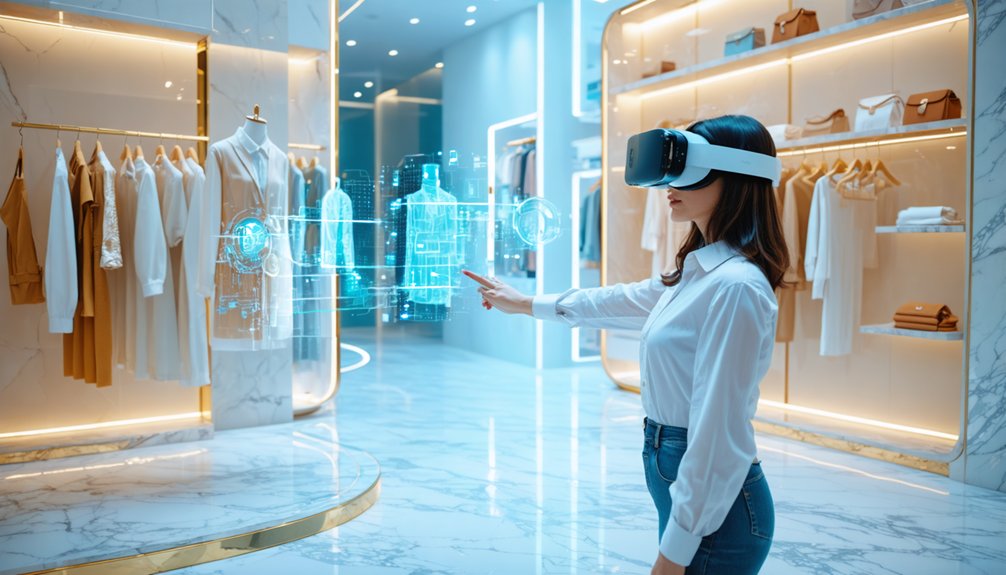

Augmented reality overlays realistic 3D products onto a shopper’s real‑world view, enabling in‑context evaluation and tactile‑like interaction on smartphones or browsers. It boosts engagement by up to 94%, lifts conversion rates, and reduces returns by 30% through accurate visual fit and scale. Features such as PBR textures, real‑time calibration, and gesture controls build confidence, while mobile‑first deployment reaches 90% of U.S. shoppers. Continuing further reveals deeper insights on implementation and ROI measurement.
Key Takeaways
- AR overlays digital products onto real‑world environments, letting shoppers evaluate items in context and boosting engagement by up to 94%.
- Virtual try‑ons and 3D visualizations increase conversion rates by 30‑94% and reduce returns by about 30%, especially for apparel and furniture.
- Realistic PBR rendering, interactive scaling, and real‑time calibration build confidence in fit, shade, and size, driving higher average order values.
- Mobile‑friendly AR experiences reach over 90% of U.S. shoppers, with Gen Z and Millennials showing strong preference for AR‑enabled purchases.
- Integrated analytics track impressions, dwell time, and interaction rates, enabling precise ROI measurement and continuous campaign optimization.
What Is AR Shopping and Why It Matters?
By overlaying digital products onto real‑world environments, AR shopping transforms how consumers evaluate items before purchase. It delivers immersive storytelling, allowing shoppers to visualize three‑dimensional goods within their own spaces, and offers sensory accessibility through tactile‑like interactions on standard smartphones or browsers.
Virtual try‑ons replace static images, letting users rotate, scale, and experiment with apparel, makeup, or home décor without physical contact. This depth of exploration builds emotional bonds, raising engagement rates by 94 % and fostering loyalty.
Personalization features enable real‑time customization, reinforcing a sense of belonging to brands that respect individual taste. Consequently, AR shopping enhances confidence, reduces decision fatigue, and positions retailers to meet modern expectations for convenience, inclusivity, and shared experiences. 71% of shoppers would shop more if AR were more available. Reduced return rates further improve profitability by minimizing post‑purchase dissatisfaction. Adding AR‑enabled product visualisation increases conversion rates by allowing customers to preview items in their own space before buying.
How AR Boosts Conversion Rates and Cuts Returns
AR’s ability to render products in three dimensions directly within a shopper’s environment translates immersive exploration into measurable business outcomes. Retailers report a conversion uplift of up to 94 % for items with AR content, and AR users enjoy a 90 % lift compared with non‑AR shoppers. In apparel and jewelry, baseline rates of 5–6.5 % rise sharply when virtual try‑ons are offered, while 3D visualizations can add as much as 40 % more conversions. Simultaneously, realistic previews drive return reduction by aligning expectations with delivered products, especially for high‑ticket items such as furniture. Brands like Ulta Beauty and Gucci have demonstrated that AR‑enabled try‑ons not only boost purchase intent but also lower post‑purchase dissatisfaction, reinforcing loyalty and increasing average order values. Over 90% of American shoppers are already using or are open to using AR for purchases. Exponential growth in AR/VR adoption is driven by hardware advancements that lower implementation barriers for retailers. 3.6 billion smartphones are AR‑compatible, ensuring widespread access to these experiences.
Key AR Shopping Features That Drive Consumer Confidence
Nearly every leading retailer now relies on a core set of AR capabilities—virtual try‑on, 3D product visualization, real‑time customization, and immersive engagement—to transform uncertainty into confidence, driving higher conversion rates and markedly lower return volumes.
Realistic Rendering delivers lifelike textures and accurate lighting, allowing shoppers to assess fit, shade, and placement before purchase.
Interactive Scale lets users manipulate dimensions instantly, reinforcing trust in size and proportion.
Data shows virtual try‑on reduces returns by 30 % and extends session time to seven minutes, while 3D visualizations lift conversion by 94 %.
Real‑time customization further fuels willingness to pay premiums, and immersive storytelling creates a shared, belonging‑rich environment that 71 % of consumers favor AR AR‑enabled retailers. Asia Pacific expected to grow at a CAGR of over 35% from 2025 to 2030, driven by rapid urbanization, exponential e‑commerce growth, and widespread mobile adoption. 200 M users engage with AR daily on Snapchat. AR market is projected to reach $87.3 B in 2025.
Generational Preferences for AR Shopping
Consistently, data reveal that younger shoppers—particularly Gen Z and Millennials—drive the strongest demand for AR‑enhanced retail experiences. Gen Z leads with 92 % preferring AR for online purchases and 60 % citing a personal feel, while 58 % discover products via Social Commerce. Millennials share the enthusiasm, with 81 % believing AR improves in‑store shopping and 65 % demanding personalization.
Both cohorts gravitate toward Personalized Avatars and Virtual Fitting, as 48 % express interest in virtual dressing rooms and 28 % favor AR for clothing choices. This generational affinity translates into higher brand loyalty, reduced purchase hesitation, and a willingness to engage with AR‑rich ads, positioning AR as a cornerstone of future retail strategies. The market for AR in retail is projected to reach $61.3 B by 2031, reflecting a rapid growth driven by consumer demand.
Choosing Mobile vs. AR Glasses for Your Store
When retailers weigh the options, the decision hinges on balancing hands‑free convenience with widespread accessibility. AR glasses provide true mobility, LIDAR‑driven 3D overlays, and contactless payments that liberate staff to focus on customer interaction. However, adoption remains low, and the extra hardware can complicate staff training and inventory management logistics.
Mobile devices, used by 70 % of shoppers, require no additional gear, integrate seamlessly with existing payment apps, and support rapid, cost‑effective development of virtual try‑ons. They also simplify training, as employees already use smartphones daily. Ultimately, stores must evaluate whether the immersive, hands‑free experience of glasses justifies the higher implementation cost and operational complexity compared with the broader reach and ease of mobile AR.
Brands That Boosted Sales With AR
Retailers seeking tangible proof of AR’s commercial impact now turn to the success stories of brands that have woven immersive technology into their sales funnels. Brand case studies illustrate how Sephora’s Virtual Try‑On Experience, paired with its Artist bot, turned makeup selection into a confidence‑boosting ritual, driving higher conversion rates during seasonal campaigns.
L’Oréal’s acquisition of ModiFace enabled the Style My Hair app and Facebook AR ads, turning hair‑color exploration into a shareable event that directly linked discovery to purchase.
IKEA Place’s room‑scan accuracy reduced returns and lifted sales up to 40 %, while Uniqlo’s Magic Mirror and Nike Fit’s foot‑measurement AR cut sizing uncertainty, fostering community loyalty. Together these examples confirm AR’s role as a catalyst for measurable revenue growth.
Implementing AR Shopping: Step‑by‑Step 3D Try‑On Guide
Launch a seamless AR shopping experience by following a structured, four‑phase workflow that moves from strategic planning through asset preparation, campaign building, and final integration testing.
In the planning phase, teams define scope, select suitable products such as eyewear or apparel, and compile metadata into a CSV for early usability testing.
Asset preparation converts CAD files into optimized GLB models, applying PBR textures and reducing polygons for mobile performance, while real time calibration guarantees accurate fit.
Campaign building leverages an AR builder to upload models, configure API authentication, and enable gesture controls, wishlists, and sharing toggles.
Integration testing embeds the widget, validates loading speed, gathers user feedback, and refines the experience before deployment, fostering a cohesive community of confident shoppers.
Measuring AR Shopping ROI: Metrics and Tools
Through precise measurement of conversion uplift, average order value, and dwell time, brands can quantify the financial impact of augmented‑reality shopping experiences. Key metrics include conversion rate uplift, AOV increase, revenue per visitor, dwell time, interaction rate, and return‑rate reduction, with performance benchmarks such as 94 % conversion boost and 33 % AOV rise.
Tools like Google Analytics, Meta Pixel, Shopify integration, unique UTM‑tagged URLs, and dedicated AR analytics capture impressions, engagement, and session length while respecting privacy implications through anonymized tracking.
ROI is calculated by [(Benefits – Costs)/Costs] × 100, exemplified by a 75 % return on a $350 k gain versus $200 k spend.
Case studies—from Gunners to IKEA—demonstrate measurable gains, reinforcing community confidence in AR‑driven commerce.
References
- https://bayelsawatch.com/augmented-reality-statistics/
- https://sqmagazine.co.uk/augmented-reality-statistics/
- https://scoop.market.us/augmented-reality-statistics/
- https://www.datainsightsmarket.com/reports/augmented-shopping-1452448
- https://www.admetrics.io/en/post/e-commerce-trends-2025
- https://patentpc.com/blog/ar-vr-market-growth-30-key-stats-you-should-know
- https://www.style3d.ai/blog/what-makes-ar-fashion-shopping-apps-essential-in-2026/
- https://www.businessresearchinsights.com/market-reports/ar-in-retail-market-117149
- https://www.zakeke.com/blog/ar-in-retail-examples-benefits-user-guide/
- https://incontextsolutions.com/blog/augmented-reality-in-retail-benefits/