

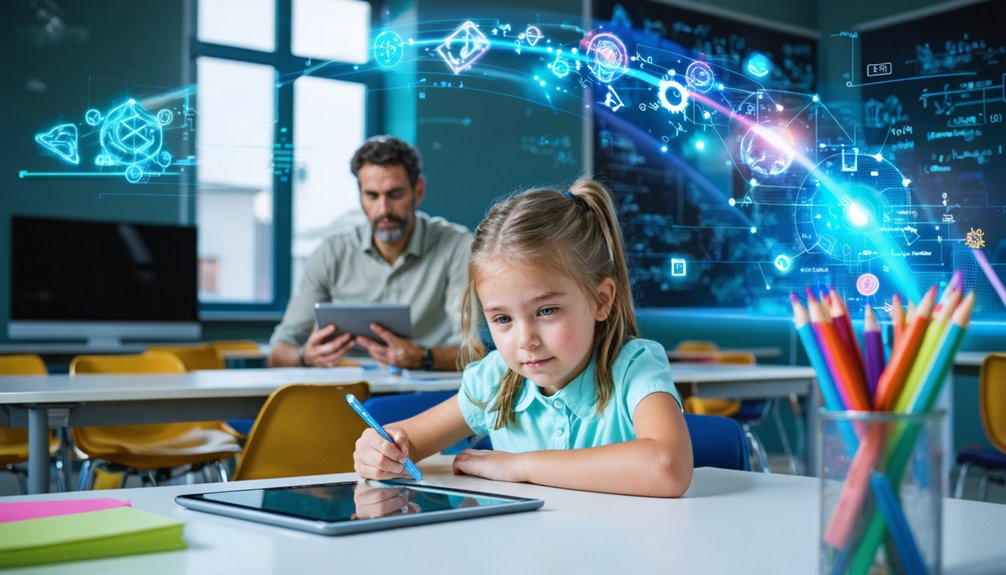

AI personalizes student learning by continuously analyzing real‑time performance data and adjusting content difficulty, modality, and pacing to match each learner’s unique gaps and strengths. Adaptive algorithms craft microlearning modules that prevent redundancy while maintaining ideal challenge, boosting engagement up to 60 % and knowledge retention up to 68 %. Real‑time feedback loops instantly correct errors and trigger remedial reviews, raising test scores by 15‑33 % across subjects. Platforms that integrate RAG‑based grounding and bias‑aware design further enhance trust and equity, and teachers benefit from up to 45 % automation of routine tasks. Continued exploration reveals deeper insights into implementation strategies and future trends.
Key Takeaways
- Adaptive algorithms analyze real‑time performance data to tailor content difficulty, keeping learners in their optimal challenge zone.
- Modality matching aligns instructional media (visual, auditory, kinesthetic) with each student’s preferred learning style, boosting engagement.
- Microlearning modules and instant feedback loops provide personalized remediation, preventing redundancy and accelerating skill acquisition.
- AI‑driven diagnostics generate granular skill maps, enabling teachers to design individualized learning pathways and targeted interventions.
- RAG‑based tutoring grounds responses in vetted curriculum resources, ensuring trustworthy, bias‑aware personalization for diverse learners.
Why AI Personalized Learning Matters for Modern Classrooms
In today’s classrooms, AI‑driven personalization reshapes learning by aligning instruction with each student’s motivation, pace, and preferences. The data show a 75 % rise in motivation and measurable confidence gains, especially for learners needing extra support. Adaptive algorithms craft curricula that respond to real‑time performance, fostering deeper engagement and higher achievement.
Research shows that one‑on‑one tutoring can produce significantly higher learning gains than traditional group instruction. However, ethical considerations arise when data are collected and decisions are automated; transparency and consent remain paramount. Equity challenges also surface, as disparate access to technology can widen gaps for underserved communities. By confronting these issues—ensuring inclusive design, safeguarding privacy, and providing equitable resource distribution—AI can fulfill its promise of a supportive, belonging‑centered educational environment. adaptive learning technologies enable real‑time adjustment of content based on each student’s progress. The NeuroBot TA’s RAG‑based approach also demonstrates how grounding AI responses in vetted course materials can boost student trust and reduce hallucinations.
How AI Tailors Lessons to Each Student’s Skill Level
AI‑driven systems move beyond motivation to directly match instructional difficulty with each learner’s demonstrated skill, using real‑time performance data to pinpoint proficiency and gaps.
Diagnostic dashboards aggregate test results, response latency, and error patterns, generating a granular skill map that guides content sequencing.
Modality matching then aligns presentation style—graphical visualizations for visual learners, interactive simulations for kinesthetic learners—with the identified zone of proximal development.
As learners progress, the platform recalibrates difficulty, maintaining optimal challenge and accelerating skill acquisition by up to 45 %.
This personalized trajectory reinforces self‑efficacy, sustains persistence, and yields measurable gains: 68 % higher knowledge retention, 73 % overall outcome improvement, and a 0.42‑standard‑deviation lift in mathematics achievement.
AI‑powered tutoring expands support to 24/7 personalized assistance.
The review highlights implementation gaps in adaptive learning systems across rehabilitation curricula.
Why Adaptive Learning Boosts Engagement by Up to 60
Elevate learner engagement by harnessing real‑time feedback loops that instantly correct errors, dynamically adjust difficulty, and trigger remedial reviews when needed.
Adaptive platforms analyze each interaction, then employ microlearning modules that match the learner’s current proficiency, preventing redundancy while maintaining challenge.
Sensory adaptation tailors content delivery to visual, auditory, or kinesthetic preferences, fostering a sense of inclusion and belonging.
Empirical studies report up to 60 % higher engagement scores when algorithms monitor disengagement cues and switch formats or add gamified incentives.
Continuous performance assessment enables seamless progression, while flexible pacing lets learners accelerate or decelerate without frustration.
The resulting personalized flow state translates into higher completion rates, sustained motivation, and measurable improvements in classroom participation.
Adaptive systems also detect learning gaps in real time, prompting targeted interventions that keep learners on track.
Research partnerships with Learnovate and PEL have shown that pass rate improvements of up to 15 % are achievable when adaptive feedback is combined with real‑time analytics.
data silos across LMS and SIS platforms can limit the effectiveness of these adaptive feedback loops.
How AI Improves Test Scores and Retention
A growing body of evidence shows that AI‑powered tutoring systems raise test scores by up to 33 % in mathematics and deliver average gains of 15–30 % across subjects, with effect sizes ranging from d = 0.72 to g = 0.73.
Controlled trials reveal that GPT‑4 tutors improve math outcomes by 33 % and that Q‑learning adaptive platforms generate 30 % gains versus a 15 % control.
Assessment fidelity is heightened through real‑time diagnostics, enabling precise content alignment and measurable mastery.
Integrated motivation mechanisms—gamified prompts, personalized feedback, and adaptive pacing—extend daily study duration by 41.5 % and correlate with higher retention (r = 0.261).
Low‑baseline learners experience up to 12.3‑point lifts, while overall satisfaction exceeds 78 %, confirming AI’s role in fostering both achievement and lasting engagement.
Thinkverse’s AI‑first platform demonstrates that personalized tutoring can amplify these gains across diverse K‑12 environments.
Real‑World Success Stories of AI‑Powered Personalized Tutoring
Success stories of AI‑powered personalized tutoring illustrate measurable gains across diverse learner profiles. In community partnerships, schools report that 85 % of students with learning disabilities achieve higher performance and confidence after AI‑driven gap analysis and customized plans. Real‑time,, step‑by‑‑step explanations, and adaptive pacing enable mastery before progression, while ethical oversight guarantees data privacy and bias mitigation.
A 7th‑grader, Emily Johnson, rose from a C‑ to B+ in math after 12 weeks of daily sessions, increasing problem‑solving speed by 30 % and accuracy to 90 %. Overall, average math grades improve 75 %, test scores rise 12 %, and 80 % of learners report heightened engagement, confirming that AI tutoring, when responsibly governed, cultivates belonging and sustained academic growth.
How Teachers Cut Administrative Work With AI Assistants
By automating routine tasks, AI assistants liberate teachers to focus on instruction rather than paperwork. Automated grading systems now handle up to 45 % of routine teacher tasks, cutting grading time by as much as 70 % and saving an average of 5.9 hours per week—equivalent to six weeks of instructional time each school year.
Correspondence drafting tools generate parent‑teacher notes, policy updates, and student alerts, reducing email volume and liberating educators for direct engagement. Attendance recording, scheduling, and document management are also streamlined, while workflow automation routes applications and approvals without manual intervention.
These efficiencies create a collaborative environment where teachers feel supported, valued, and more connected to their professional community.
Avoid the 5 Biggest Pitfalls in Deploying AI‑Personalized Learning
Steering the rollout of AI‑personalized learning demands vigilant avoidance of five critical pitfalls that can undermine both equity and efficacy.
First, data‑privacy risks must be mitigated through robust consent frameworks and secure storage, recognizing that children‑specific protections differ from adult‑centered norms.
Second, algorithmic bias threatens fairness; models require culturally sensitive training data and systematic bias‑mitigation pipelines.
Third, teacher‑training gaps demand targeted professional development and resource support to prevent overwhelm and guarantee confident integration.
Fourth, the digital divide can entrench inequity; equitable access strategies and collective‑interest designs are essential to reach diverse learners.
Fifth, overreliance on automation risks depersonalization; balanced human‑AI collaboration preserves emotional support and nuanced instruction, fostering a sense of belonging for every student.
Pick the Best AI Platform for Your Classroom and Future Trends
Amid rapid advances in educational technology, selecting the ideal AI platform hinges on aligning core capabilities—real‑time adaptive pathways, multilingual support, and seamless integration—with institutional goals.
Educators seeking teacher autonomy gravitate toward CYPHER Learning, whose Copilot automates course creation while preserving instructional control, and toward TeachBetter.ai, which delivers structured simulations and AI‑generated assessments that teachers can customize.
Data privacy remains paramount; Docebo and 360Learning embed robust compliance frameworks, limiting student data exposure while still providing personalized learning paths.
Future trends point to generative agents that draft lesson plans, multilingual‑aware skill mapping, and hybrid lecture‑capture integration. Schools that prioritize these emerging features will secure scalable, compliant solutions that foster community, empower teachers, and sustain long‑term student growth.
References
- https://virtualspeech.com/blog/ai-training-statistics
- https://programs.com/resources/ai-education-statistics/
- https://tutorflow.io/blog/how-ai-is-transforming-education-2026
- https://www.facultyfocus.com/articles/teaching-with-technology-articles/designing-the-2026-classroom-emerging-learning-trends-in-an-ai-powered-education-system/
- https://www.insightaceanalytic.com/report/ai-in-personalized-learning-and-education-technology-market/2692
- https://www.x-pilot.ai/blog/future-ai-education-2026-trends-report
- https://edtechmagazine.com/k12/article/2026/03/ai-tools-support-personalized-learning-k-12-education
- https://schoolai.com/blog/exploring-ais-role-in-modern-education/
- https://learningsciences.smu.edu/blog/artificial-intelligence-in-education
- https://home.dartmouth.edu/news/2025/11/ai-can-deliver-personalized-learning-scale-study-shows