

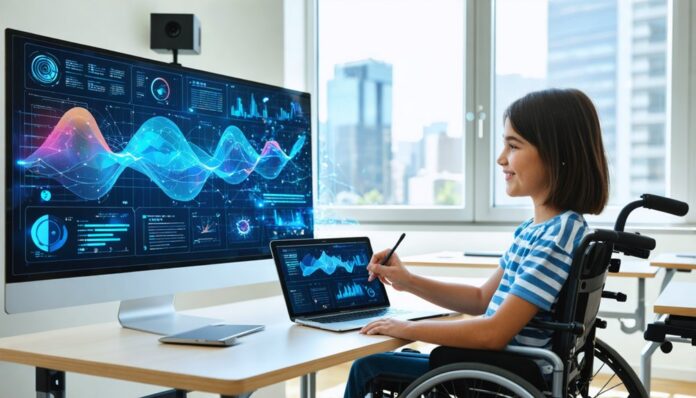

Hybrid learning merges flexible online scheduling with face‑to‑face sessions, allowing multimodal delivery of videos, podcasts, and interactive labs that cater to varied learning styles. Real‑time captioning, screen‑reader compatible materials, and adaptive platforms provide essential accommodations, boosting engagement for students with disabilities. Structured pacing and clear deadlines reduce scheduling conflicts, while broadband upgrades and shared device programs address connectivity gaps for low‑income and rural learners. The approach narrows achievement gaps for under‑represented groups, and further details reveal how to implement these practices effectively.
Key Takeaways
- Hybrid schedules let students with limited internet bandwidth attend in‑person sessions, reducing reliance on unstable connectivity.
- Multimodal content (videos, podcasts, captions) satisfies diverse sensory needs and supports screen‑reader and text‑to‑speech tools.
- Real‑time captioning and transcription in synchronous classes boost engagement for learners with hearing or processing disabilities.
- Flexible assessment options (timed extensions, multimodal submissions) align with UDL principles, enabling all learners to demonstrate mastery.
- Faculty training on accessibility and universal design ensures consistent implementation of WCAG‑AA standards across hybrid courses.
Why Inclusive Hybrid Learning Meets Student Preferences
Because it blends the scheduling flexibility of online coursework with the immediacy of face‑to‑face instruction, inclusive hybrid learning aligns closely with student preferences. Data show that 51 % of BSIT students cite flexible scheduling as the primary draw, and 84.31 % of hybrid‑preferring respondents prioritize this attribute. The model’s dual‑mode delivery satisfies diverse learning styles by offering multimodal resources—videos for visual learners, podcasts for aural learners, and interactive labs for kinesthetic participants. Parents, with 46 % support, reinforce the community’s desire for adaptable timetables that accommodate personal responsibilities. By integrating synchronous classroom interaction with asynchronous digital content, hybrid programs foster a sense of belonging while respecting individual time constraints, thereby meeting the nuanced expectations of today’s student body. Technological challenges remain a barrier, with over half of hybrid learners reporting frequent internet connectivity problems. Two‑thirds of students reported positive perceptions of university support for hybrid learning. Demographic influence shows that specialization and year of study affect hybrid learning preferences.
What Evidence Shows Inclusive Hybrid Learning Improves Scores for Under‑Represented Groups
Evidence demonstrates that inclusive hybrid learning markedly boosts academic performance for Hispanic and Black students, narrowing longstanding achievement gaps. A comparative study of a single course revealed that low‑structured face‑to‑face instruction produced the lowest exam scores, whereas a highly structured hybrid format (50 % in‑person, 50 % online) yielded materially higher scores for these groups. Path analysis shows a robust coefficient of 0.550 (p < 0.001) linking hybrid design to academic performance, with effect size d = 0.87 in quasi‑experimental gains. Meta‑analytic results confirm a large overall impact (d ≈ 1.03). These findings underscore cultural responsiveness and flexibility as mechanisms that close achievement gaps, offering under‑represented students equitable access to personalized, mastery‑oriented instruction. Hybrid models also address the documented technology access barriers that disproportionately affect low‑income and rural students. The study found that the hybrid learning approach did not significantly differ from traditional methods in overall academic success, suggesting that its benefits may be most pronounced for specific demographic groups.
Universal Design Principles for Inclusive Hybrid Learning
By integrating the three Universal Design for Learning (UDL) pillars—engagement, representation, and action and expression—hybrid courses can eliminate barriers and foster equitable achievement.
Engagement is cultivated through self‑regulation tools, goal‑oriented feedback, and collaborative structures that sustain motivation.
Representation expands comprehension by clarifying vocabulary, symbols, and syntax while delivering content through text, audio, video, and captioned media, ensuring sensory accommodations for diverse learners.
Action and expression are supported with flexible communication media, tiered practice, and options for physical or digital response, allowing students to demonstrate mastery in preferred formats.
Accessible assessment aligns with these principles, offering varied question types, timed extensions, and multimodal submission pathways.
Together, these design choices create a barrier‑free hybrid environment that promotes belonging, agency, and inclusive success.
Essential Accessibility Tools for Inclusive Hybrid Learning
Real-time captioning and transcription platforms have become foundational pillars of inclusive hybrid learning, delivering synchronized text overlays for 89 % of web‑conferencing sessions and boosting engagement for 92 % of students with disabilities. Institutions that embed Real time captioning alongside Adaptive interfaces report higher participation rates, as 79 % of learners adopt these tools for synchronous classes. Student engagement remains the biggest challenge, cited by 54 % of respondents, underscoring the importance of these tools. Screen‑reader compatibility and text‑to‑speech modules further expand access, with 82 % of schools mandating support in digital policies. Adaptive learning platforms, such as AI‑driven scenario tools, tailor content to individual strengths, satisfying ISTE+ASCD principles and improving exam outcomes for under‑represented groups. Assistive technologies integrated with video and interactive media raise retention by 25‑60 %, narrowing achievement gaps and fostering a sense of belonging across diverse hybrid cohorts.
Faculty Support Strategies for Inclusive Hybrid Learning
Empowering faculty with robust technical infrastructure and targeted professional development is essential for delivering inclusive hybrid learning. Institutions must provide high‑quality audio‑visual gear, dedicated tech office hours, and on‑site assistants who resolve disruptions instantly, allowing instructors to focus on pedagogy.
Structured peer mentorship programs enable seasoned educators to share best practices, troubleshoot classroom dynamics, and refine inclusive strategies.
Thorough training sessions and online resource kits familiarize faculty with synchronous‑asynchronous balance, collaborative digital whiteboards, and LMS integration.
Continuous feedback loops—student surveys, mid‑semester check‑ins, and data analytics—inform iterative improvements. By embedding these support mechanisms, faculty can create equitable, engaging environments where every learner feels connected and valued.
Equity‑First Guidelines for Designing Inclusive Hybrid Spaces
In designing hybrid learning environments, an equity‑first approach mandates that every spatial and technological element be calibrated to eliminate the divide between remote and in‑room participants.
Guideline one requires universal design for learning principles, embedding captioning, assistive technologies, and low‑tech materials so all learners experience equal presence.
Guideline two insists on high‑speed, user‑friendly video and audio systems that maintain synchronous interaction without latency.
Guideline three calls for flexible furniture and demountable walls that transform classrooms into adaptable zones, supporting hands‑on activities for any modality.
Guideline four emphasizes student agency through co‑design workshops, where diverse voices shape acoustic layouts, visual displays, and interaction protocols.
Guideline five embeds continuous feedback loops, aligning institutional equity goals with measurable outcomes and reinforcing a belonging‑centric culture.
Common Barriers and How to Overcome Them in Hybrid Implementation
Addressing the myriad obstacles that impede hybrid learning requires a systematic analysis of technological, pedagogical, and equity dimensions.
Infrastructure barriers manifest as unstable internet, insufficient device pools, and under‑resourced labs, disproportionately affecting rural and low‑income campuses. Institutions must prioritize broadband upgrades, shared device programs, and resilient network architectures to safeguard continuous connectivity.
Simultaneously, Time management challenges arise when students juggle synchronous sessions and asynchronous tasks; 12 % report difficulty sustaining schedules. Structured pacing guides, clear deadline calendars, and responsive support services mitigate these pressures.
Faculty development must include hands‑on training to bridge digital literacy gaps, while institutional policies should embed equitable resource allocation. Together, these measures create a cohesive hybrid environment that fosters inclusion and belonging.
Actionable Checklist to Launch Inclusive Hybrid Learning Today
By aligning technology, content, interaction, timing, and communication with WCAG 2.1 AA standards, institutions can move from planning to execution with a concrete, step‑by‑step checklist that guarantees accessibility from day one.
First, select a platform that supports screen‑reader navigation, keyboard control, and text magnification to 200 % without content loss; prioritize tools with built‑in accessibility checkers such as Canvas.
Second, apply the Canvas Accessibility Checklist and supplemental checklists for Word, PDF, PowerPoint, and video, ensuring alt text, transcripts, and WCAG‑AA contrast.
Third, configure all interactive elements for keyboard access, clear focus order, and avoid hover‑only actions.
Fourth, remove fixed time limits or provide adjustable timers, and require user‑initiated media playback with pause/stop controls.
Finally, embed a syllabus statement on accommodations, announce policies verbally, and train faculty using universal‑design resources, while employing assistive tech and flexible assessment to support every learner.
References
- https://er.educause.edu/articles/2023/2/hybrid-learning-and-space-reimagination-optimizing-access-and-equity-to-promote-student-success
- https://www.kneoworld.com/accessibility-of-hybrid-learning-models/
- https://oidigitalinstitute.com/news/how-hybrid-and-online-learning-supports-student-accessibility-and-affordability/
- https://campustechnology.com/articles/2021/09/09/survey-accessibility-challenges-persist-as-hybrid-and-online-learning-continues.aspx
- https://www.gettingsmart.com/2025/02/17/diving-into-the-evidence-virtual-and-hybrid-models-as-high-quality-school-choice-options/
- https://files.eric.ed.gov/fulltext/EJ1410414.pdf
- https://www.livewebinar.com/blog/education/2021-hybrid-learning-statistics-in-a-nutshell
- https://pmc.ncbi.nlm.nih.gov/articles/PMC11241882/
- https://dl.acm.org/doi/full/10.1145/3711670.3764652
- https://www.chepp.org/wp-content/uploads/2024/07/CHEPP_ACCESSIBILITY_WHITE-PAPER_v5.pdf